

Counter-UAS
Counter-Drone Technology: How Militaries Defeat UAVs — Page 2
Radar, jamming, lasers, interceptors and drone-on-drone — how counter-UAS works, who leads it, and who is legally allowed to shoot a drone down.
Last updated:
25 news articles on Counter-UAS ↓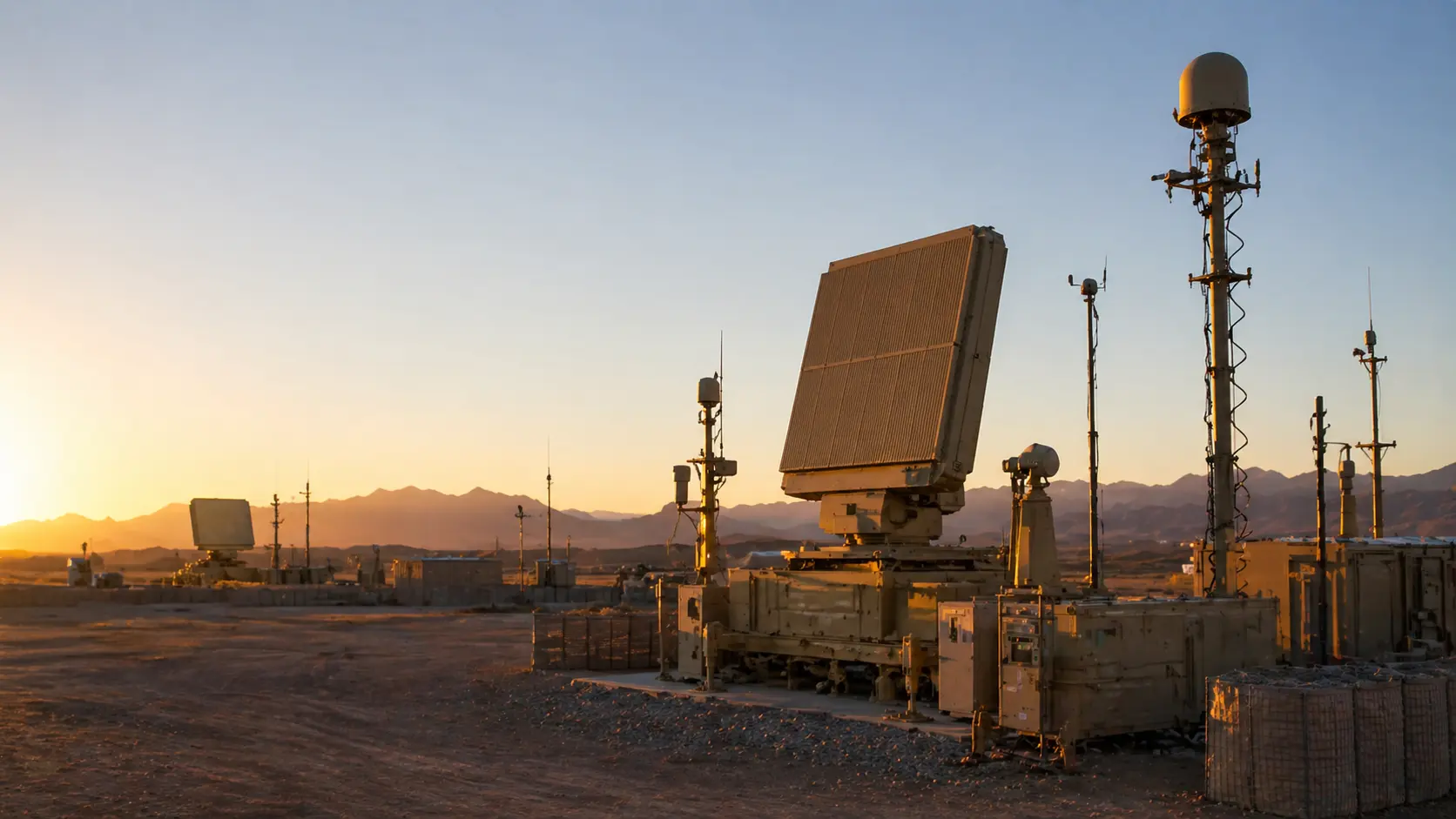
Guide overview
Governments announced more than $53 billion in counter-drone contracts in the first eight months of 2026. For comparison, the analyst forecasts this guide used to quote had the entire global market reaching $20 billion by 2030. The market research was not slightly behind. It was describing a different industry.
Two other things changed the picture this year. On 2 September the US Army awarded AeroVironment $464.8 million for LOCUST X3 laser weapons — the first production contract for a high-energy laser in US history, which moves directed energy out of the demonstration phase it has occupied for a decade. And in July, a new rule gave American state and local police the legal authority to bring a drone down themselves, which until then almost nobody outside a short federal list could do.
The technology stack has not changed much. Detect, classify, track, identify, decide, defeat, assess. What changed is money, legal authority, and the fact that some of this is now being bought in production quantities rather than tested.
What Is Counter-UAS Technology?
Counter-UAS is the business of detecting, tracking, identifying and defeating unmanned aircraft that threaten military forces, critical infrastructure or civilians. It barely existed as an organised defense sector before 2016.
The US Army alone requested $994 million for small counter-UAS procurement in FY2027, against $596 million enacted for FY2026. The comparison is worth reading carefully: the whole FY2027 request is discretionary, while FY2026’s total split into $336 million discretionary and $260 million in mandatory reconciliation spending. Measured discretionary to discretionary it is a 195% rise; measured against the total the Army actually received, it is closer to double. Either way the direction is the same, and the Army anticipates asking for $1.4 billion in FY2028. Across the whole department, the FY2027 request earmarks roughly $20 billion for counter-drone work inside a $75 billion drone and counter-drone total. JIATF 401, the Joint Interagency Task Force set up in 2025 to coordinate counter-drone efforts across government, asked for $580.3 million in research and development against $6.5 million the year before.
Inside that request, $414 million goes to operational counter-UAS — batteries, expeditionary platforms, mobile sensors — $165 million to fixed-site defense, and $132 million to effectors, including 24 units of the Next Generation Counter-UAS Missile that AeroVironment builds as Freedom Eagle-1. The directed-energy line is $66 million, modest against the rest and, as the laser section below shows, no longer the whole picture.
The core problem is arithmetic. A $500 FPV drone has destroyed tanks worth $2-5 million in Ukraine. A Coyote Block 2 interceptor costs somewhere around $100,000-$200,000 per shot. Fire a Patriot-class missile at a commercial-grade kamikaze drone and you lose the exchange by a factor in the thousands.
Every serious development in this field is an attempt to fix that ratio. Lasers do it by making the shot nearly free. High-power microwave does it by defeating many drones at once. Drone-on-drone does it by making the interceptor as cheap as the threat.
How Are Drones Detected?
Detection is the foundation. The dominant approach pairs radar with RF sensing and uses EO/IR cameras to confirm what the other sensors found. Acoustic adds a cheap passive layer in the right conditions.
Radar
Radar is still the primary detection method for small UAS. Raytheon’s KuRFS is the US Army’s main counter-UAS radar, paired with Coyote interceptors in LIDS, the Low, Slow, Small UAS Integrated Defeat System. It gives 360-degree coverage and detects Class 1 drones past 15 km. The Pentagon awarded Raytheon $5.04 billion in September 2025 for KuRFS radars, Coyote interceptors, launchers and support through 2033.
Robin Radar’s IRIS reaches 12 km against small drones including Shahed-class munitions, weighs 29 kg and works on the move. HENSOLDT’s Spexer 2000 3D radar serves with the Bundeswehr in the GUARDION field-camp protection system. Fortem’s TrueView R20 AESA radar runs under 7 kg at 38 watts and cues the DroneHunter interceptor.
RF and Signal Detection
RF detection identifies a drone by its control link, video downlink or Remote ID broadcast. Its real advantage is that it can geolocate the operator as well as the aircraft, when the controller is transmitting. Defeating the person is often more useful than defeating the airframe.
Dedrone’s RF-360 classifies roughly 600 drone models with direction-finding to 8 km in good conditions. Sentrycs takes the protocol-takeover route instead of brute-force jamming. DroneShield’s RfOne MkII does RF direction-finding to 8 km. Anduril’s Lattice pulls Pulsar electronic warfare sensors, Sentry radar towers and WISP infrared cameras into one fire-control picture.
Passive sensing has become its own procurement category. Hidden Level received a $100 million Other Transaction Authority award in July 2026 to scale passive RF sensing across Department of War customers — its systems listen rather than transmit, which matters for installations that do not want to advertise their own sensor emissions. The award is a contracting route rather than guaranteed revenue, and no detection ranges or deployment schedules were published with it.
RF detection has a hard limit. Autonomous drones, fiber-optic FPVs and pre-programmed one-way attack drones emit little or nothing. Against those, radar and acoustics carry the load.
Acoustic Detection
Passive acoustic arrays pick up propeller and motor signatures. They are cheap, passive and cannot be jammed, which makes them useful for cuing when other sensors are saturated.
Ukraine runs the largest operational acoustic network in the world: roughly 14,000 low-cost nodes under Sky Fortress, for less than $5 million in total, used to detect Shahed-type drones and cue sirens and higher-end intercept systems.
The limitations are real. Range is typically 300-500 metres in the field and falls away in wind above 5 m/s, rain, urban traffic and anywhere near artillery. The US Army issued a request for information in January 2026 for Group 1 and 2 acoustic detection that works on the move and feeds Tactical Assault Kit — treating acoustic as a soldier-level layer, not a primary sensor.
EO/IR and AI Sensor Fusion
EO/IR cameras are the identification layer: they confirm whether a radar or RF track is a drone, a bird, an airliner or a false positive. Controp’s SPEED-ER reaches 40 km for land-based surveillance.
Fusion platforms correlate radar, RF, acoustic and optical feeds to cut false alarms and automate the kill chain. Anduril’s Lattice was selected by JIATF 401 in March 2026 as the enterprise tactical command-and-control layer for US government counter-UAS, with a first task order of $87 million. Dedrone’s Tracker.AI runs at more than 955 sites globally. Ukraine’s Sky Map platform, built for Shahed detection, was deployed by US personnel at Prince Sultan Air Base in Saudi Arabia in April 2026.
How Does Electronic Warfare Counter Drones?
RF Jamming
Jamming overpowers the control link, video feed or navigation signal. What happens next depends on the drone’s firmware: hover, return to home, descend, or crash. Handheld systems reach 500 m to 2 km, vehicle-mounted beyond 5 km.
DroneShield’s DroneGun Mk4 weighs 3.2 kg and is fielded with several Western militaries; the DroneGun Tactical reaches 1-2 km. Dedrone’s Defender 2 is protocol-specific rather than broadband, which reduces collateral interference in crowded RF environments. Safran’s Skyjacker, tested on French Navy frigates and used during the Paris Olympics, combines jamming with GNSS spoofing at 1-10 km.
GPS Spoofing
Spoofing feeds false positioning signals to redirect or crash a GNSS-dependent drone. Ukraine has used it extensively against Russian Shaheds, with documented cases of drones diverted into Belarus or empty fields, and built the national Pokrova system to spoof GPS along the line of contact.
It only works on drones that trust GNSS. By 2025 both sides had pushed hard into inertial navigation, visual-inertial odometry, terrain-referenced navigation, pre-programmed routes, frequency agility and fiber-optic links that skip RF altogether. Jamming and spoofing still work well against commercial-grade platforms. Against purpose-built military systems hardened for contested airspace, less and less.
What Are Directed Energy Weapons for Counter-Drone?
High-Energy Lasers
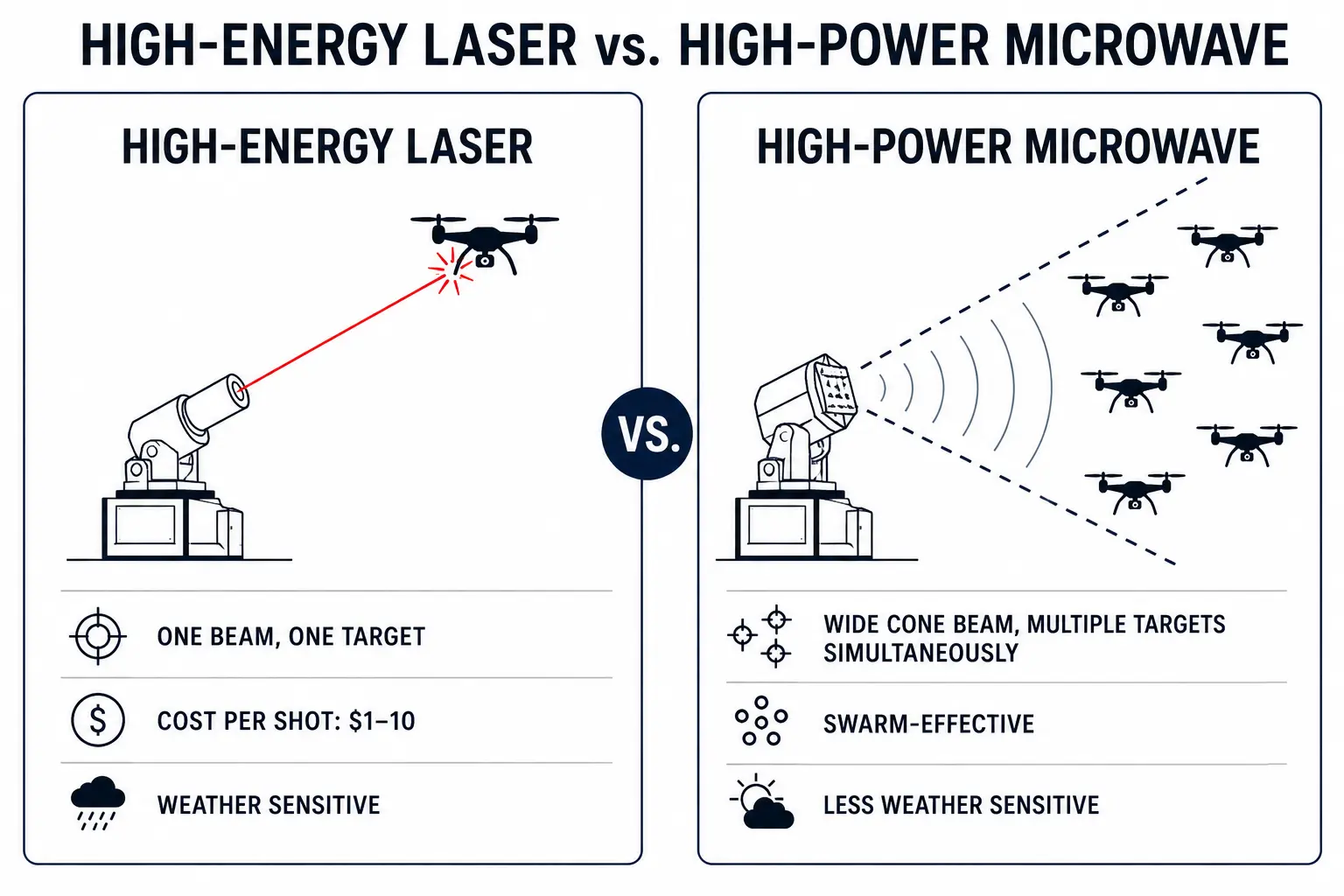
Lasers burn a point on the target until something structural, optical or electrical fails. Cost per shot is electricity — roughly $1-10, against $100,000 or more for a kinetic interceptor. The constraint is physics: weather, smoke, dust and atmospheric turbulence degrade the beam, and a 2-5 second dwell per target limits how fast you can work through a swarm.
The category crossed a threshold on 2 September 2026. The US Army awarded AeroVironment $464.8 million under the Enduring-High Energy Laser programme for LOCUST X3, a 30 kW system aimed at Group 1-3 drones, with delivery of “well into the dozens” of units expected over the next few years. It is the first production contract for a high-energy laser weapon in US history. Every other programme on this page is still a prototype, a demonstrator or a shipboard trial.
The rest of the field: the US Navy’s HELIOS, a 60 kW Lockheed Martin system on USS Preble, has downed drones in testing. Israel’s Iron Beam, a Rafael 100 kW-class fiber laser, is the most operationally proven, with a cost per shot estimated at $2-3.50 and confirmed combat use. The UK’s DragonFire, 50 kW from MBDA, Leonardo and QinetiQ, hit roughly £10 per shot and is contracted for Royal Navy Type 45 destroyers from 2027 under a £316 million deal.
High-Power Microwave
HPM emits a directed electromagnetic pulse that damages electronics across an area rather than burning one point. That makes it the natural answer to swarms — a single engagement can defeat dozens of drones, where a laser is one-to-one by construction.
Epirus’s Leonidas is the most commercially mature: solid-state, software-defined gallium nitride, with Gen II units reaching roughly 2 km. The Army awarded Epirus $66.1 million in 2023 for IFPC-HPM prototypes, delivered all four by March 2024, and followed with a $43.5 million Gen II contract in July 2025. In August 2026 the Marine Corps added an $11 million contract through the Office of Naval Research for HAVOC, which puts an Epirus HPM system on a universal sled mount so it can move between crewed and uncrewed ground vehicles.
In December 2025 Leonidas became the first HPM system demonstrated against fiber-optic FPV drones. That matters more than the contract values: fiber-optic guidance exists specifically to defeat RF jamming, and HPM is currently the most credible counter to it.
The Air Force Research Laboratory’s THOR is a containerised HPM system that flies on a C-130 and assembles in about three hours with two people. Leidos is building the follow-on Mjölnir.
What Kinetic Systems Kill Drones?
Missile Interceptors
Raytheon’s Coyote is the Army’s primary missile-based counter-sUAS interceptor, at roughly $100,000-$200,000 per shot for Block 2. Block 3NK is a reusable non-kinetic variant. The September 2025 $5.04 billion contract covers launchers, kinetic and non-kinetic effectors, KuRFS radars and support through 2033. Enduring Shield, from Leidos and Dynetics under IFPC Increment 2, took a $617 million award in April 2026, bringing total IFPC production contracts near $1.2 billion.
Anduril’s interceptors have gone export. In June 2026 the State Department approved a possible $1.98 billion sale to Kuwait built around Roadrunner-M and Anvil kinetic interceptors, bundled with electronic warfare, sensors and Lattice command and control as a single counter-drone network. That is one of the largest counter-UAS foreign military sales ever notified.
Gun-Based Systems
Rheinmetall’s Skyranger 30 and 35 are the benchmark mobile gun systems. The 30 mm fires 1,250 rounds per minute to roughly 3 km using programmable AHEAD airburst ammunition; the 35 mm reaches 4 km. Germany ordered a prototype plus 18 vehicles for about €595 million, with a potential programme of 600-plus systems that could exceed €9 billion. Rheinmetall has also put Skyranger on the uncrewed Ripsaw M5.
The US Navy’s Phalanx CIWS — 20 mm, 4,500 rounds per minute, 1.5 km — has Block 1B variants adapted for small UAS, though the economics only work when what you are protecting is very valuable.
Net Capture
OpenWorks’ SkyWall Patrol is a shoulder-fired net launcher reaching about 100 m, with parachute recovery so the drone survives for forensics. Fortem’s DroneHunter F700 is an autonomous interceptor that uses onboard radar to chase and net its target; the Army awarded Fortem an $18 million three-year contract in 2026. Net capture earns its place in urban and sensitive environments where falling debris is unacceptable.
What Is Drone-on-Drone Interception?
Ukraine made this mainstream. Interceptor drones at $1,000-$2,000 each, used against Shahed-type drones, invert the cost exchange that every other method loses. Ukrainian forces intercepted 2,975 Russian drones in January 2026 and 7,674 in March.
US programmes are industrialising it. Fortem’s DroneHunter is in Army service, Anduril’s Anvil is integrated with Lattice and has been demonstrated at NORTHCOM’s Falcon Peak exercises, and Coyote Block 3NK adds a reusable non-kinetic option.
The economics are compelling and the preconditions are demanding. Cheap interceptors need reliable detection, fast cueing, autonomous target acquisition and airspace deconfliction. Without that sensor and command infrastructure underneath, drone-on-drone creates as many problems as it solves.
Who Is Actually Allowed to Shoot Down a Drone?
For most of the past decade the answer in the United States was: almost nobody. Counter-drone authority sat with a short list of federal agencies. A police department watching a drone over its own stadium could see it on a display and do nothing.
That changed with the SAFER SKIES Act, enacted as Title LXXXVI of the FY2026 National Defense Authorization Act and signed on 18 December 2025. The implementing interim final rule — issued jointly by Homeland Security and Justice — took effect on 1 July 2026.
It creates two tiers. A detection-and-warning certification allows detecting, identifying, monitoring, tracking, warning and confiscation. A mitigation certification goes further: disrupting, interfering with, seizing control of or destroying an aircraft using reasonable force.
The obligations are substantial. A certified agency needs an implementation policy, an approved technology list, an operations plan, coordination and notification arrangements, and real-time notification to air traffic control. Mitigation actions must be reported within 48 hours, with semiannual operational summaries.
The gap between the rule and reality is the story. The rule states that the FBI’s National Counter-UAS Training Center has trained and certified operators from roughly 46 agencies. The government’s own paperwork anticipates about 1,850 participating. Legal authority arrived years ahead of the training pipeline to use it.
For anyone selling counter-drone equipment to US domestic customers, that gap is the addressable market. For anyone responsible for a venue, it is the reason a system you are legally allowed to own may still sit unused.
How Do Militaries Layer C-UAS Defenses?
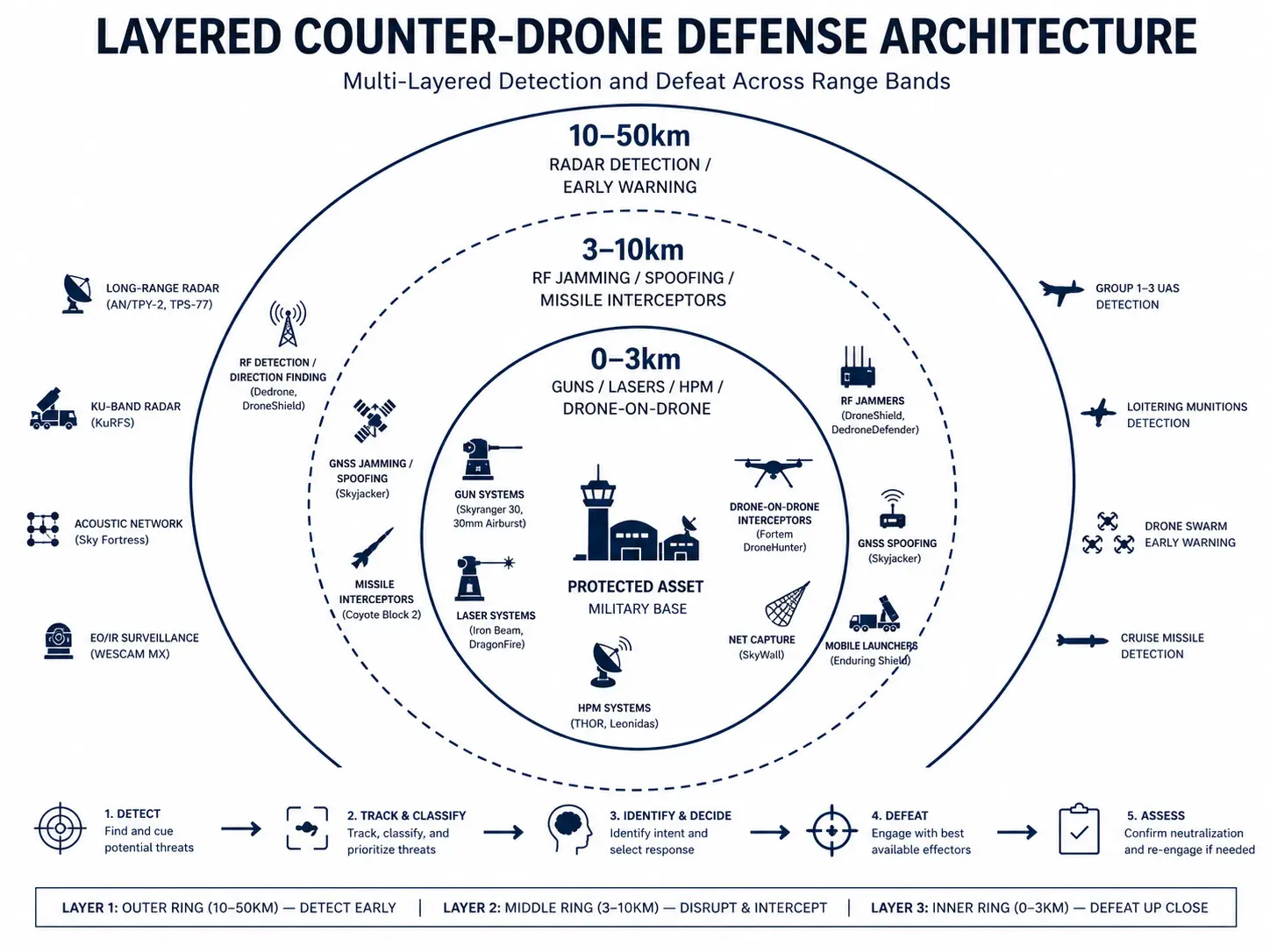
No single technology handles every threat at every range. Modern architectures are deliberately layered: wide-area sensors for early warning, soft-kill in the middle, hard-kill on the inside.
The US Army pairs KuRFS radar with Coyote for the tactical layer, adds electronic warfare and Leonidas HPM for point defense, and ties it together through FAAD C2 and increasingly Anduril Lattice. IFPC Increment 2 bridges short-range air defense and Patriot-class systems. LOCUST X3 will slot into the inner layer as it fields.
Israel runs the most mature stack. Iron Dome takes rockets and some drones, Drone Dome adds radar, RF, EO/IR and jamming for local counter-UAS, and Iron Beam is the innermost directed-energy layer that pulls down the cost per intercept.
Europe is building its own. The European Commission published an Action Plan on Drone and Counter Drone Security on 11 February 2026, turning the political “drone wall” idea into the European Drone Defence Initiative and folding it into the Defence Readiness Roadmap with a dedicated drone and counter-drone capability area. Officials talk about an early capability in 2026 — realistically radar and sensors with light mitigation — and an EU-level legal framework for counter-UAS by 2030. Separately the European Defence Fund committed €1.07 billion across 57 defence projects, with significant drone and counter-drone content.
National procurement is running ahead of the EU framework. France’s PARADE programme awards Thales and CS Group roughly $370 million. Poland’s SAN programme, a Kongsberg and PGZ consortium for 18 counter-UAS batteries, is valued around $4.2 billion.
Which Companies Lead the C-UAS Market?
RTX / Raytheon — the largest single contractor by value. KuRFS plus Coyote generated the $5.04 billion September 2025 multiyear award.
Anduril Industries — command and control plus autonomous interceptors. The Army awarded it a $20 billion ten-year contract vehicle in March 2026, with the first task order counter-drone work at $87 million through JIATF 401, and the State Department approved a $1.98 billion Kuwait package in June.
AeroVironment — absent from earlier versions of this guide and now impossible to leave out. The BlueHalo acquisition brought counter-UAS and directed energy in-house, and LOCUST X3 gives it the first US production contract for a high-energy laser weapon at $464.8 million.
Epirus — high-power microwave specialist and the only US HPM system in Army field service. $66.1 million in 2023, $43.5 million Gen II in 2025, $11 million Marine Corps HAVOC award in August 2026, and a $250 million Series D taking total funding past $550 million.
DroneShield — Australian RF detection and jamming pure play, listed on the ASX as DRO. First-half 2026 revenue was a record A$125.8 million, up 74%, with recurring revenue up 229%. It reaffirmed full-year guidance of A$250-270 million while posting a statutory loss of A$32.2 million as it builds production capacity.
Hidden Level — passive RF sensing, with a $100 million OTA vehicle awarded in July 2026 covering hardware, software and its Airspace Monitoring Service.
Fortem Technologies — drone-on-drone net capture, with an $18 million three-year Army contract in 2026 pairing TrueView radar with DroneHunter.
Dedrone / Axon — sensor fusion and RF, acquired by Axon in 2024, with Tracker.AI at more than 955 sites.
Rheinmetall — mobile short-range air defense. Roughly €595 million of Skyranger orders from Germany with potential expansion past €9 billion.
Leidos / Dynetics — IFPC Increment 2 launchers, $617 million in April 2026, total production contracts near $1.2 billion.
SRC Inc. — LIDS radar and electronic warfare integration, including a Qatar sale reported around $1 billion.
What Is Driving Demand?
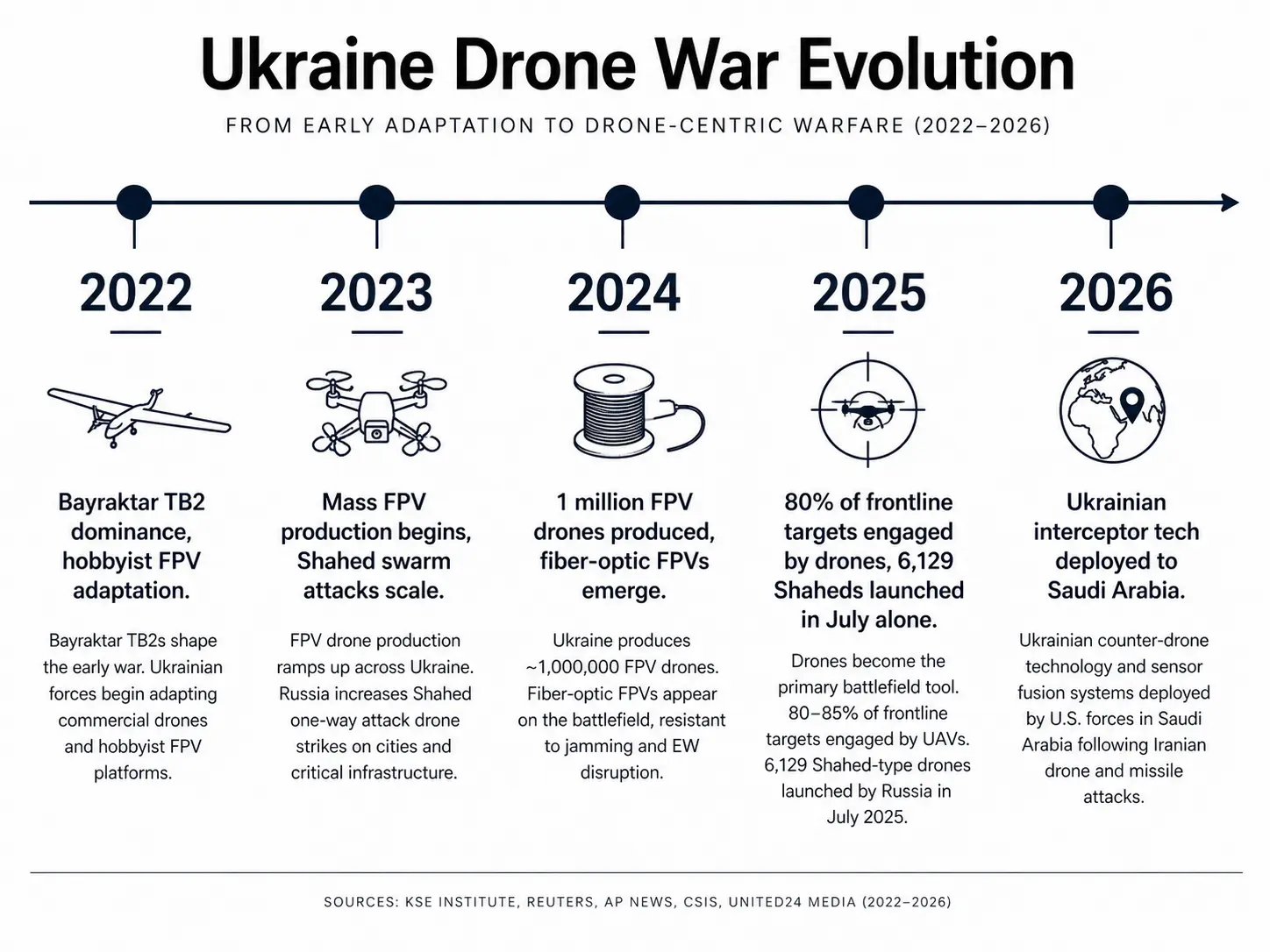
Ukraine reset procurement everywhere. Kyiv School of Economics data showed drones engaging 80-85% of frontline targets by mid-2025, with at least 215,000 drone strikes recorded that summer. Russia launched 6,129 Shahed-type drones in July 2025 alone, 741 of them in a single night. Mass drone attack became a normal military method, and counter-UAS moved from niche capability to tier-one priority.
The Red Sea confirmed the cost problem. Reuters reported the US Navy spending more than $1 billion in munitions defending ships from Houthi drones and missiles between late 2023 and early 2025, firing roughly 200 SM-2, SM-3 and ESSM missiles at threats costing a tiny fraction of that. The argument for directed energy stopped being theoretical there.
Incursions over home installations did the rest. NORTHCOM reported hundreds over US bases, with Langley Air Force Base seeing drone activity for 17 consecutive days in December 2023. US air bases in the UK — Lakenheath, Mildenhall, Feltwell and Fairford — faced prolonged incursions in late 2024, prompting British troop deployments and emergency counter-UAS installation.
How Big Is the Counter-Drone Market?
Be careful with market-size forecasts in this sector. They have been consistently wrong in the same direction.
The figure this guide used to lead with — MarketsandMarkets at $6.64 billion in 2025 growing to $20.31 billion by 2030 — has already been overtaken. Unmanned Airspace counted more than $53 billion in publicly announced government counter-UAS contracts in the first eight months of 2026 alone, after more than $29 billion in the first quarter.
Announced contracts and market revenue are not the same measure, and a multiyear award books over many years, so the two numbers are not directly comparable. But the gap is too large to be a definitional quibble. The forecasts were built before Ukraine normalised mass drone attack, before European rearmament, and before the FY2027 US budget request.
Treat any single market-size number here, including the ones above, as an indication of direction rather than a figure to plan against.
What to Watch Through 2027
LOCUST X3 deliveries. A production contract is not a fielded weapon. Whether AeroVironment delivers dozens of 30 kW lasers on schedule determines whether directed energy becomes a standing part of air defense or stays a decade-long demonstration.
The fiber-optic FPV problem. Fiber-optic links are immune to RF jamming and have spread well beyond Ukraine. HPM is the best current answer and Leonidas proved it in December 2025, but deployment scale is still small.
IFPC Increment 2 fielding, targeted around 2027. The interceptor competition decides whether low-cost autonomous intercept or missile-based defeat becomes the doctrine baseline for the next decade.
Whether SAFER SKIES certifications scale. 46 agencies against an expected 1,850 is the bottleneck between a domestic counter-drone market that exists on paper and one that buys equipment. Watch the FBI training centre’s throughput.
Whether drone-on-drone survives contact at scale. Ukraine has proved the economics. Nobody has yet proved that autonomous interception works reliably at volume without blue-on-blue incidents or airspace deconfliction failures. The next 18 months of field experience will settle it.
Latest Coverage
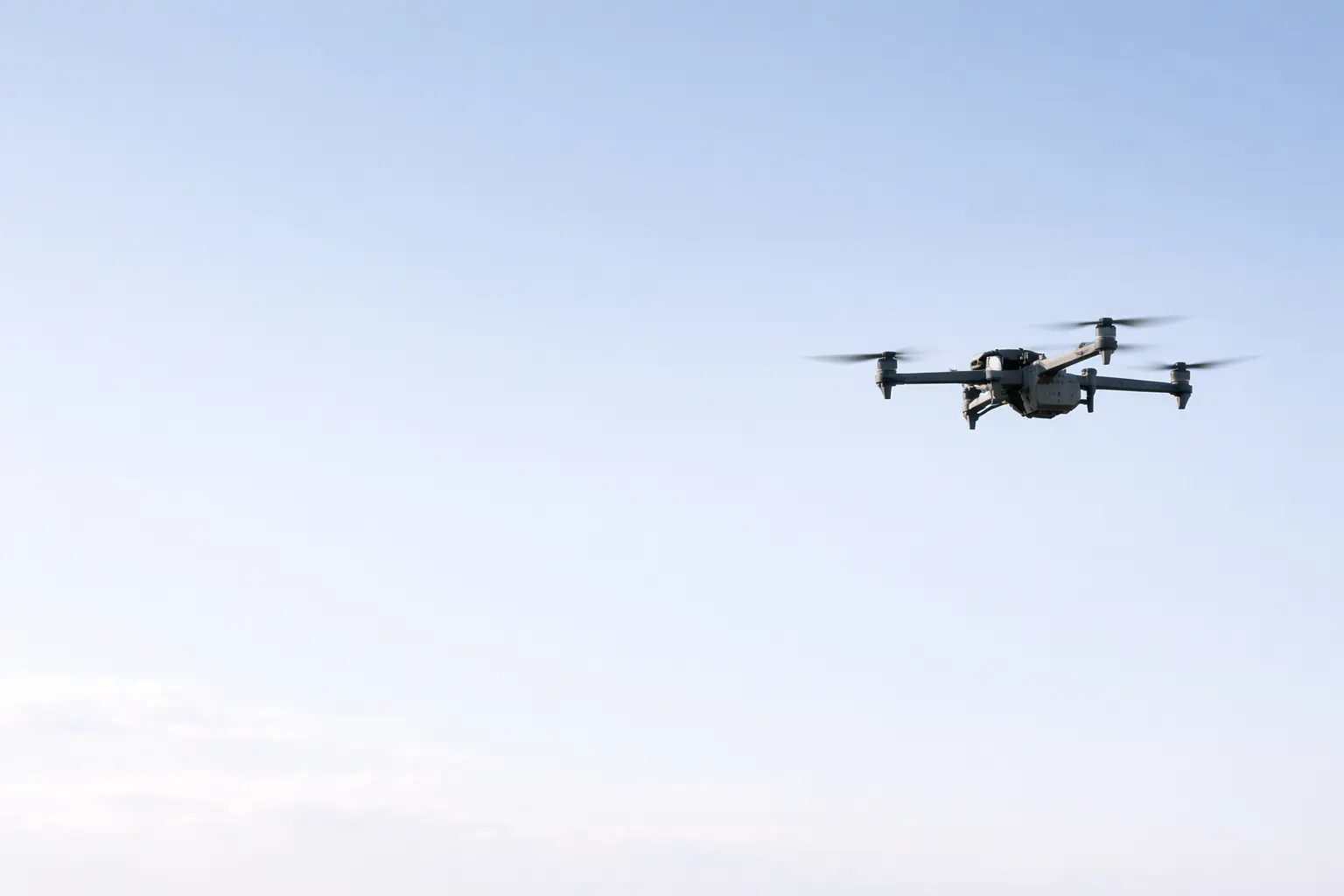
Counter-UAS Hit $29B in Q1 2026 — Anduril Took $20B
Global counter-UAS contract spending reached $29B in Q1 2026, led by a $20B ten-year Anduril award from the US Army.

Russia Launches 172 Drones at Ukraine in Single Night Attack
Russia hit Ukraine with 172 Shahed and Gerbera drones overnight April 1-2. Air defenses downed 147. Twenty-two drones struck targets across 12 locations.
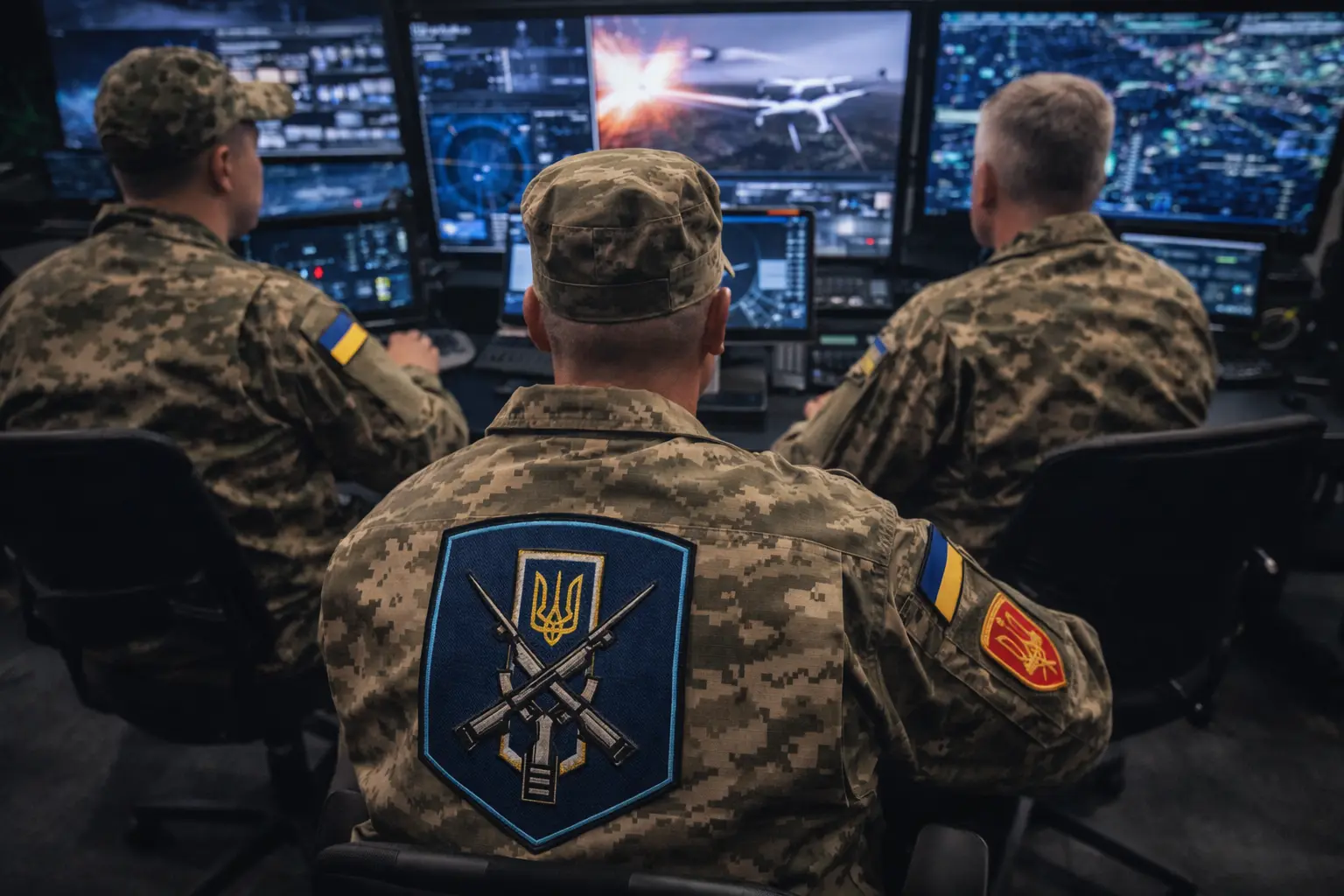
Ukraine Establishes Dedicated UAS Command
Ukraine created a standalone UAS command to centralize drone interception, backed by expanded recruitment and infrastructure.
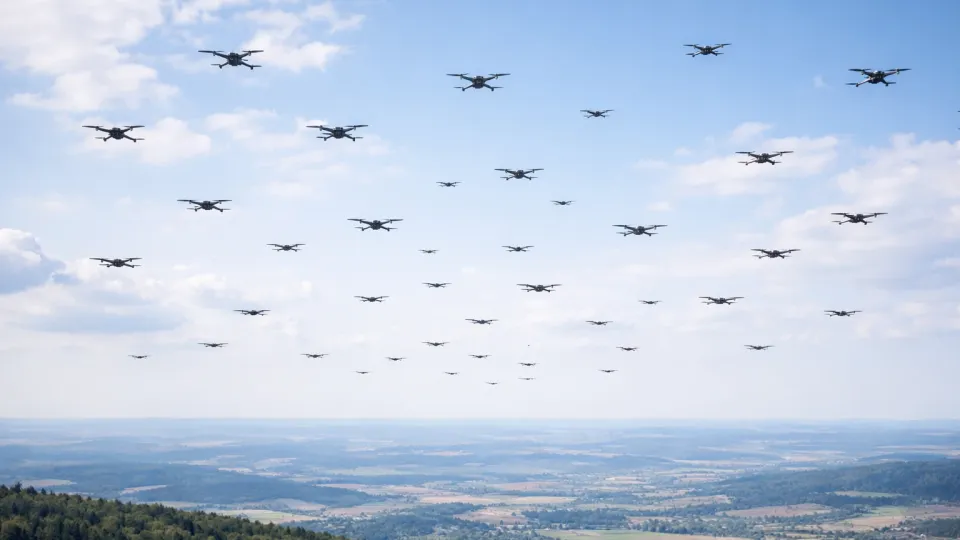
The Drone Swarm Threat Is Coming. Counter-UAS Is Not Ready.
Defense experts say armed drone swarms are the next battlefield threat — and the biggest obstacle to countering them is US military bureaucracy.
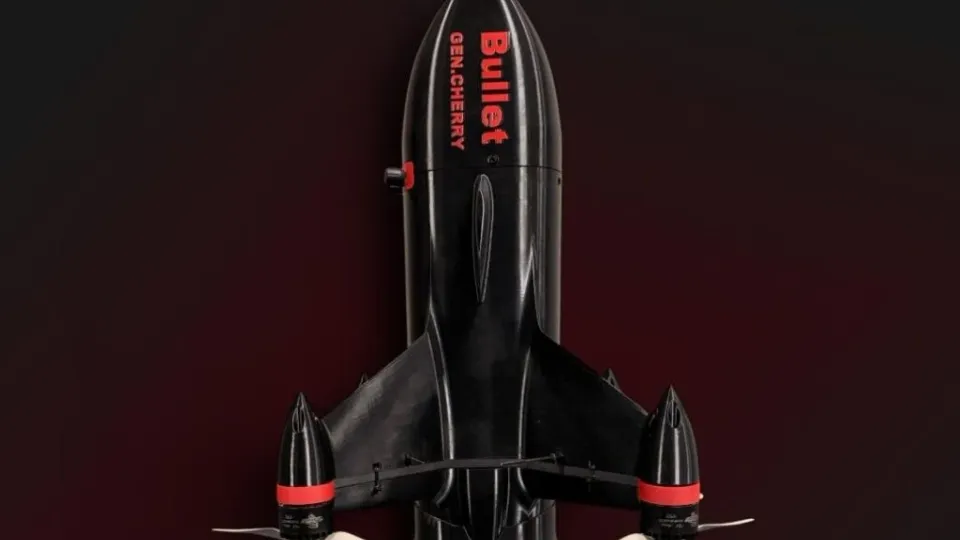
General Cherry to Build Interceptor Drones in New Hampshire
Ukrainian FPV and interceptor drone maker General Cherry has signed a deal with Wilcox Industries to manufacture UAVs at its New Hampshire facilities.
Companies
AeroVironment
US manufacturer of small tactical UAS, loitering munitions and counter-UAS systems, transformed in scale by its 2025 acquisition of BlueHalo.
United States
Anduril Industries
US defense technology company building autonomous weapons, counter-UAS, and AI command software, and manufacturing them at its own Arsenal-1 plant in Ohio.
United States
Baykar
Turkish defense company behind the Bayraktar TB2, the most widely exported armed drone of the past decade, now also the owner of Italy's Piaggio Aerospace.
Turkey
Dedrone
US counter-drone company, now part of Axon, providing airspace security platforms for military bases, prisons, airports and critical infrastructure.
United States
Fortem Technologies
US counter-drone company producing radar detection systems and autonomous interceptor drones for airspace security at airports, stadiums, and military sites.
United States
DroneShield
Australian counter-drone company producing detection, tracking, and defeat systems for military, government, and critical infrastructure customers.
Australia
Leidos
US defense and government technology contractor providing systems integration, sensing, cyber, and air and missile defense platforms for military and federal customers.
United States
Airbus
European aerospace group building commercial aircraft, military aircraft, helicopters, satellites, and uncrewed systems including the Wingman combat drone.
Netherlands
Recent Funding
Series C
Sequoia Capital, American Strategic Technology Fund, Interlagos, Valor Equity Partners, Allen & Company, Thiel Capital, Spark Capital, Dylan Field
Neros TechnologiesSeed
Rainfall Ventures, ACME Capital, Skyfall Ventures, Sisyphus Ventures, Antler, Startuplab
StendrRecent Contracts
defense
U.S. Army, AeroVironment
Delivery order for additional Switchblade 600 Block 2 loitering munitions, plus Switchblade 600...
defense
US Army PAE Fires, Anduril Industries
Three-year contract to supply a minimum of 3,000 surface-launched Barracuda-500M missiles with...
defense
US DoD Office of Under Secretary for Research and Engineering, Leidos
Three-year contract to supply 3,000 low-cost containerized missiles as part of DoD's low-cost...
defense
US Army Portfolio Acquisition Executive Fires, Anduril Industries
Three-year production agreement for a minimum of 3,000 Surface-Launched Barracuda-500M cruise...
defense
U.S. Department of Defense, Anduril Industries
Contract modification adding $100.3M to upgrade the Space Surveillance Network with mesh...