

Dedrone
US counter-drone company, now part of Axon, providing airspace security platforms for military bases, prisons, airports and critical infrastructure.
3 articles
Dedrone
Dedrone is a counter-UAS company headquartered in Washington DC that produces software-defined airspace security platforms. Its systems detect, classify and track drones using a combination of RF sensors, radar, cameras and analytics software. Its customers are military installations, correctional facilities, airports and government agencies. Since October 2024 it has operated as part of Axon Enterprise.
Key Products
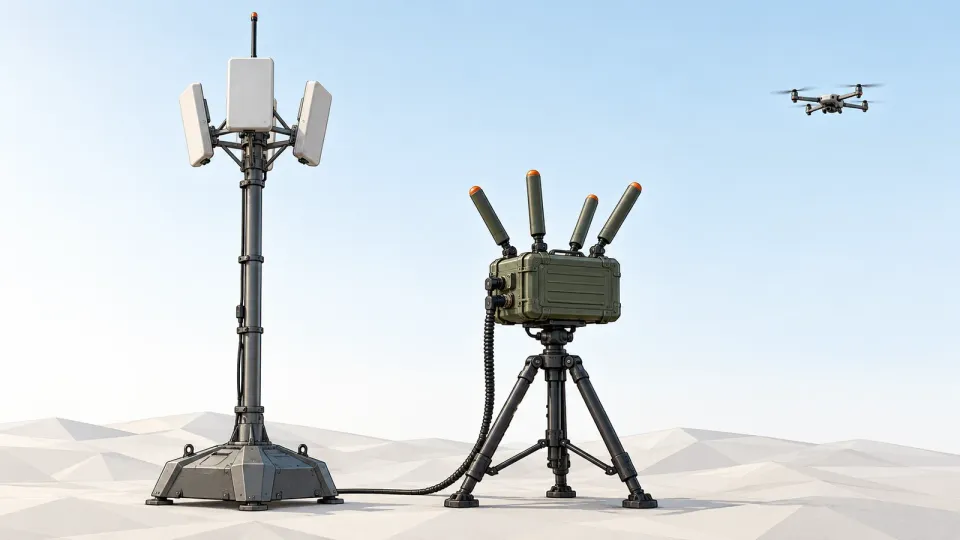
DedroneTracker — Cloud-connected software platform that aggregates sensor inputs and provides drone detection and classification across a protected site.
DedroneSensor RF-300 — Passive RF sensor that identifies drone control signals without emitting a detectable signal of its own.
Third-party defeat integration — Dedrone’s platform integrates with defeat systems from other vendors, including RF jammers and kinetic interceptors, rather than requiring its own.
Ownership and Business
Axon Enterprise, listed on the Nasdaq as AXON, announced on 30 April 2024 that it would acquire the remaining stake in Dedrone Holdings, and completed the transaction in October 2024. Axon already held roughly 20 percent of the company, and paid approximately $391.1 million in cash for the remaining interest of about 79.8 percent, subject to customary purchase price adjustments. The deal was reported at the time at approximately $400 million in total.
Before the acquisition Dedrone was venture-backed, with investors including Felicis Ventures, Target Global and Axon itself. Dedrone’s revenue is not separately disclosed within Axon’s results.
Why It Matters
The acquisition put counter-UAS capability inside a publicly traded law enforcement technology company with an established sales channel into US police departments and government agencies — a distribution advantage no independent counter-drone startup has.
Dedrone’s software-first approach is the other thing that distinguishes it. Because the platform integrates sensors and defeat systems from multiple vendors, customers are not locked into proprietary hardware, which matters in a market where detection and defeat technology is changing faster than procurement cycles. The counterpart to that flexibility is that Dedrone depends on other companies for the defeat side of the problem, which is the part subject to the tightest legal restrictions in most jurisdictions.
Wrong? Email contact@flightbrief.news with the document that shows it.
On the lists
Dedrone in the reference tables FlightBrief keeps, each checked against its official source.
DHS counter-UAS contract1 entry
Coverage
Topics
Contracts
| Date | Value |
|---|---|
| Sep 26 | $5,196,899 |
| Sep 26 | $1,412,399 |
| Sep 26 | $200,000 |
Split award for fixed and portable counter-drone capability built on a D-Fend EnforceAir2 system, task order…
Survey, installation, integration, testing and support of a counter-drone sensor suite, task order 70FA5026F00000138
Fixed and mobile radio-frequency counter-drone sensors and software, task order 70T05026F6116N004 under DHS contract…
Five-year multiple-award counter-UAS IDIQ led by the DHS Science and Technology Directorate, ordering to July 2031…