

Amazon Prime Air
Amazon's drone delivery division, running autonomous last-mile delivery in the US and UK and attempting a sixfold expansion of its service area during 2026.
2 articles
Amazon Prime Air
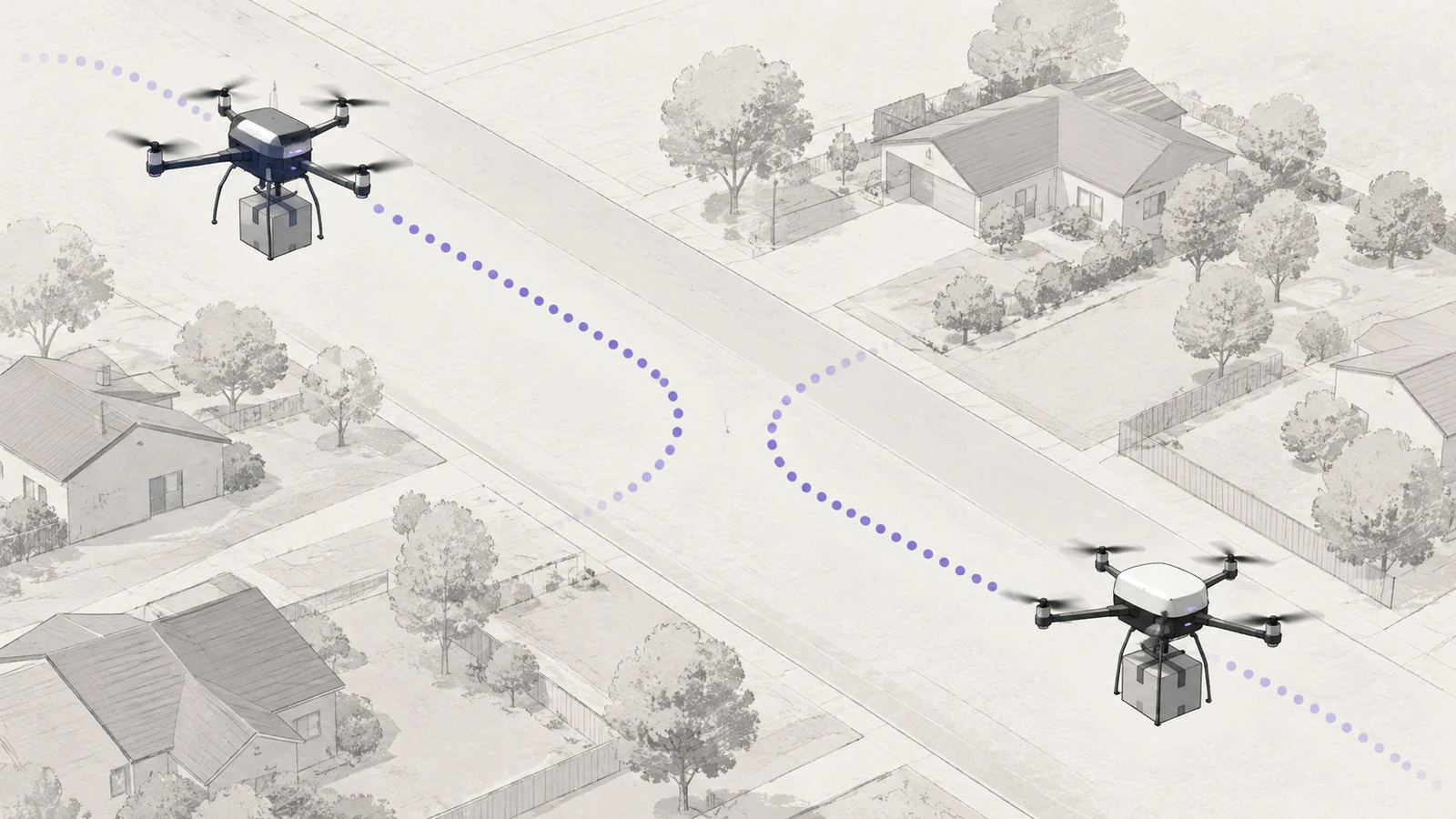
Amazon Prime Air is Amazon’s autonomous drone delivery operation, flying packages directly to residential customers within defined service areas. It has been in development since 2013 and began limited commercial deliveries in the US in 2022, first in College Station, Texas and Lockeford, California, followed by a UK launch in Darlington in 2024.
Key Products
MK30 — the current delivery aircraft, carrying payloads up to five pounds with a service radius of roughly 7.5 miles. Amazon states it has double the range and half the noise of the MK27 it replaced, and is cleared to operate in rain and at higher temperatures. It entered commercial service in 2024.
Business and Financial Position
Prime Air is a wholly owned division of Amazon and does not report separately. Amazon has invested heavily across more than a decade without disclosing figures.
The programme’s history is uneven. Amazon laid off hundreds of Prime Air staff in 2023 and scaled back expansion plans, then closed the Lockeford, California operation in 2024. Through 2025 the active footprint was small.
That changed in 2026. In August Amazon announced plans to expand drone delivery to nearly 500 US cities and towns by the end of the year, roughly a sixfold increase in its footprint, alongside expansion into additional metropolitan areas. The stated model is incremental: each site is a 7.5-mile service circle built around an existing Amazon facility.
Why It Matters
Prime Air is the most visible drone delivery programme in the world and has consistently missed its own timelines. Manna Aero has publicly claimed more commercial deliveries on a fraction of the investment, which says something about how conservative Amazon’s rollout has been.
The 2026 expansion target is the first time Amazon has committed to a number large enough to test the unit economics at scale rather than in pilots. FlightBrief analysis: the constraint is regulatory throughput as much as engineering. Each new service area needs FAA approval, and 500 sites in a single year would require an authorisation rate the agency has not previously demonstrated. Watch how many of those sites are actually flying by December, not how many are announced.
Coverage
Topics
Guides
Guide
Drone Delivery Companies: Who's Flying What in 2026
Wing, Zipline, Amazon, Manna, Flytrex, Matternet, DroneUp — where they fly, what they deliver, and why certification was not the hard part.
Guide
Drone BVLOS Rules 2026: FAA Part 108 and EU U-Space
Part 108 is in final review and could make routine BVLOS legal in the US. Europe regulated first and is now simplifying. Where both stand.
Guide
The Best Personal Drone: What You Can Actually Buy in 2026
The best personal drones of 2026, ranked by use case — and which ones you are allowed to buy where you live, because in 2026 that is the harder question.