
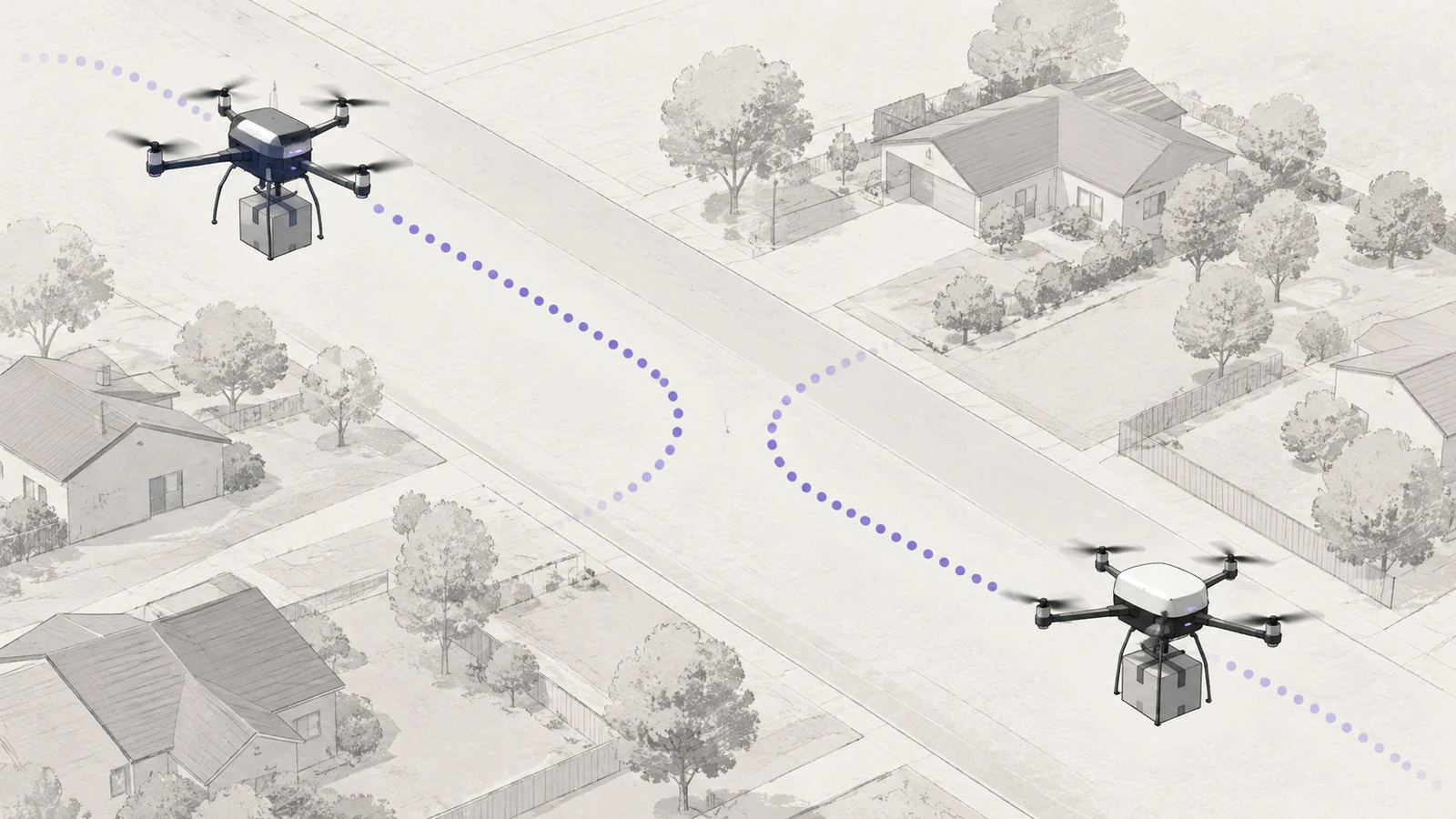
Wing and Flytrex flew roughly 8,000 overlapping delivery flights over Little Elm and Wylie, two Dallas-Fort Worth suburbs, in January and February. They were in the air together on 30 of 31 days, often for more than ten hours at a stretch. Every flight plan was deconflicted automatically and there were no airspace conflicts.
Neither system can tell the other that an aircraft is in trouble.
The two companies started exchanging flight intent data in May 2025, the first time two commercial delivery operators in the US ran unmanned traffic management in daily operations over the same airspace. Each publishes where its aircraft intend to fly and the other adjusts its routes. Nobody at Wing phones anybody at Flytrex. It runs on ASTM F3548-21, a published interoperability standard, under the FAA’s UTM Operational Evaluation — which means any operator that implements it can join.
The volume is what changed. Combined daily operations rose 215% between January and February, and Flytrex says it is now approaching 10,000 overlapping flights a month with other operators.
What they built is strategic deconfliction: aircraft agree routes before flight so they never need the same piece of sky at once. Tactical deconfliction is the other thing, and it is missing. If a Flytrex aircraft loses GPS, fails, or has to put down in a garden, Wing’s system is not automatically told. Each operator runs its own emergency and contingency procedures under its own separate FAA approvals.
That is the reverse of how air traffic control earns its keep. Keeping aircraft apart on a normal day is the easy half. Controllers exist for the moment one aircraft stops flying the plan and everybody else has to move.
The failure cases are not hypothetical — an Amazon MK30 hit a crane in Arizona last October, drawing NTSB and FAA scrutiny. And the airspace is getting busier. Wing is heading for 270 Walmart locations by 2027, Zipline has signed with Uber Eats, and DoorDash now holds its own Part 135 certificate. An unshared emergency is survivable when one operator has the suburb mostly to itself. It is harder to defend with four.
None of this makes the Dallas work less impressive. Getting two competitors to run a standards-based system in daily commercial operation, with no human coordination, is the harder organisational problem, and it is a foundation a tactical layer can be built on.
ASTM F3548-21 covers strategic coordination between providers. The emergency-state problem sits outside it, and no equivalent commercial implementation has been announced. The FAA’s Part 108 rule may force the question: it reached the White House budget office on 10 July, the last stop before publication, and would replace site-by-site BVLOS waivers with a standing framework — which means more operators in shared airspace, faster.