
Rotron Aerospace
British maker of Wankel rotary UAV engines and long-range unmanned aircraft, including the SkyLance one-way effector, owned by Nasdaq-listed Ondas since March 2026.
1 article
Rotron Aerospace makes compact Wankel rotary engines for unmanned aircraft, and increasingly the aircraft themselves. It was founded in 2008 by Gilo Cardozo as Rotron Power, growing out of a rotary engine he designed to power a paramotor flight near Everest in 2007, and was renamed Rotron Aerospace in September 2023. It operates from a facility of about 30,000 square feet in southern England. Cardozo is chief technology officer, Alex Head is chief executive, and former First Sea Lord Sir George Zambellas chairs the company.
Propulsion
The engine range is the underlying asset: single- and twin-rotor Wankels from the RT300 (roughly 31–50 hp) through the RT600, RT700 and RT1200, plus an XT100 two-stroke and an R-series turbofan. Rotron says the rotary layout delivers better power-to-weight and lower vibration than comparable piston engines, and names Lockheed Martin, Boeing and NATO-aligned governments among its customers — a company claim rather than a disclosed contract.
Air vehicles and SkyLance
The aircraft are newer: the Talon DT-150 and DT-300 VTOL platforms, the Defendor uncrewed combat aircraft, the RT-Target10 target drone, and SkyLance.
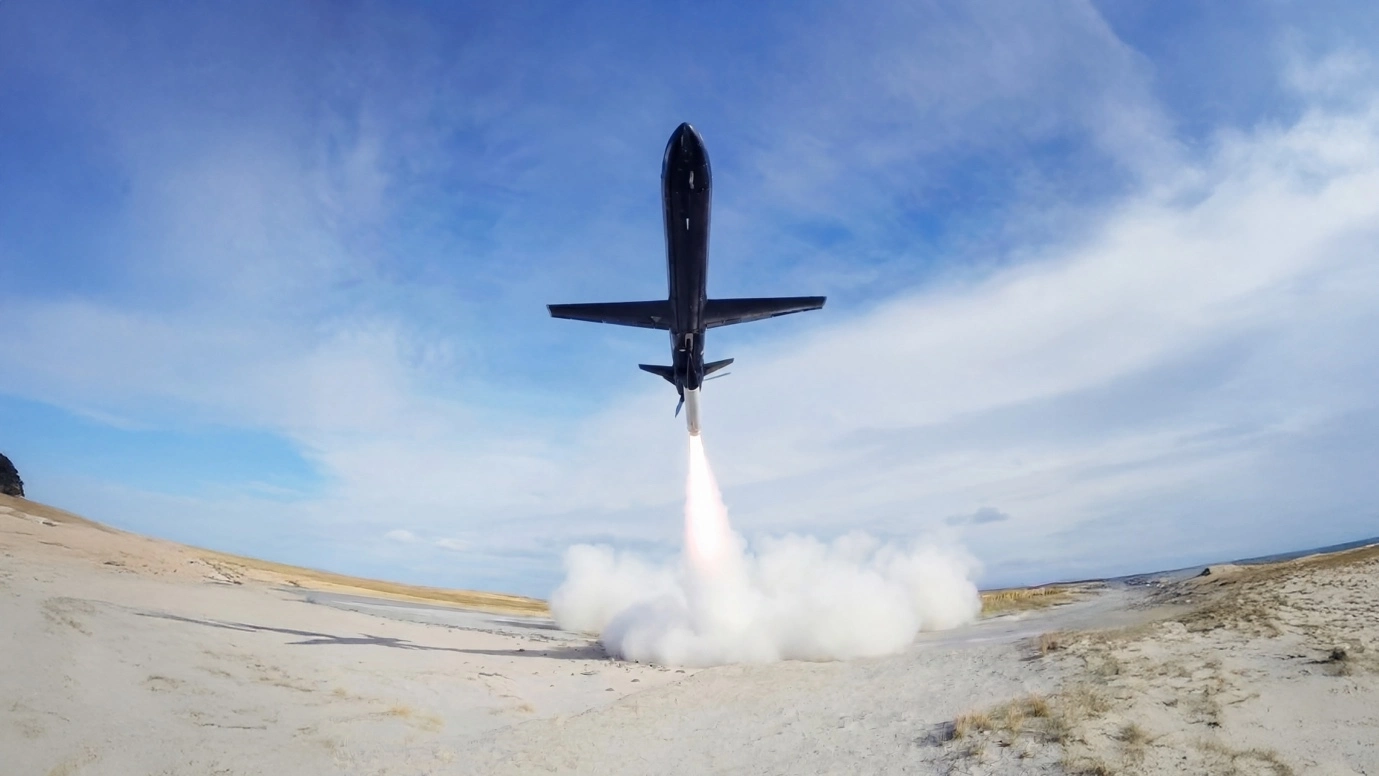
SkyLance is a long-range one-way effector — a cheap, expendable strike drone — driven by a rotary engine turning a pusher propeller, with rocket-assisted launch. Rotron announced its first firing trial on 12 May 2026 and says the tests validated propulsion and system performance; that is a demonstration, not a qualification. Reported figures put cruise speed at 600 km/h and payload at up to 300 kg, with range claims between 1,000 and 1,200 km depending on configuration.
What gives those numbers weight is the programme around them. SkyLance is one of three designs under the UK Ministry of Defence’s Project Brakestop, alongside MBDA’s Crossbow and MGI Engineering’s TigerShark, intended to supply Ukraine with long-range strike weapons built free of US-controlled components. All three were trialled at the Hebrides Range and shown at RAF Northolt in June 2026, after which the MoD issued follow-on contracts reported at around £15 million each.
Ownership
Rotron is no longer independent. Ondas Inc. (Nasdaq: ONDS) agreed to acquire it in February 2026 and completed the deal on 16 March 2026. Ondas’ first-quarter 2026 10-Q puts total consideration at roughly $83.5 million: $6.7 million in cash, 3,334,753 shares valued at $35.1 million, and $41.7 million of contingent earn-out. That earn-out is more than a third of the headline figure, which makes the price largely a bet on SkyLance converting. Rotron contributed $331,000 of revenue in the fortnight it belonged to Ondas before the quarter closed — the only public revenue figure for the business.
Why it matters
Rotron’s durable position is in propulsion, where it has a long and unglamorous track record; SkyLance is what turned it into an acquisition target. Project Brakestop gives it something rare for a company this size: a live government programme with a named end user and a deadline, where the ITAR-free requirement is a structural advantage no US supplier can match.
The unproven part is manufacturing. A £15 million follow-on is a development contract, and moving from one firing trial to attritable weapons produced in volume is the transition most one-way-effector programmes fail at.