
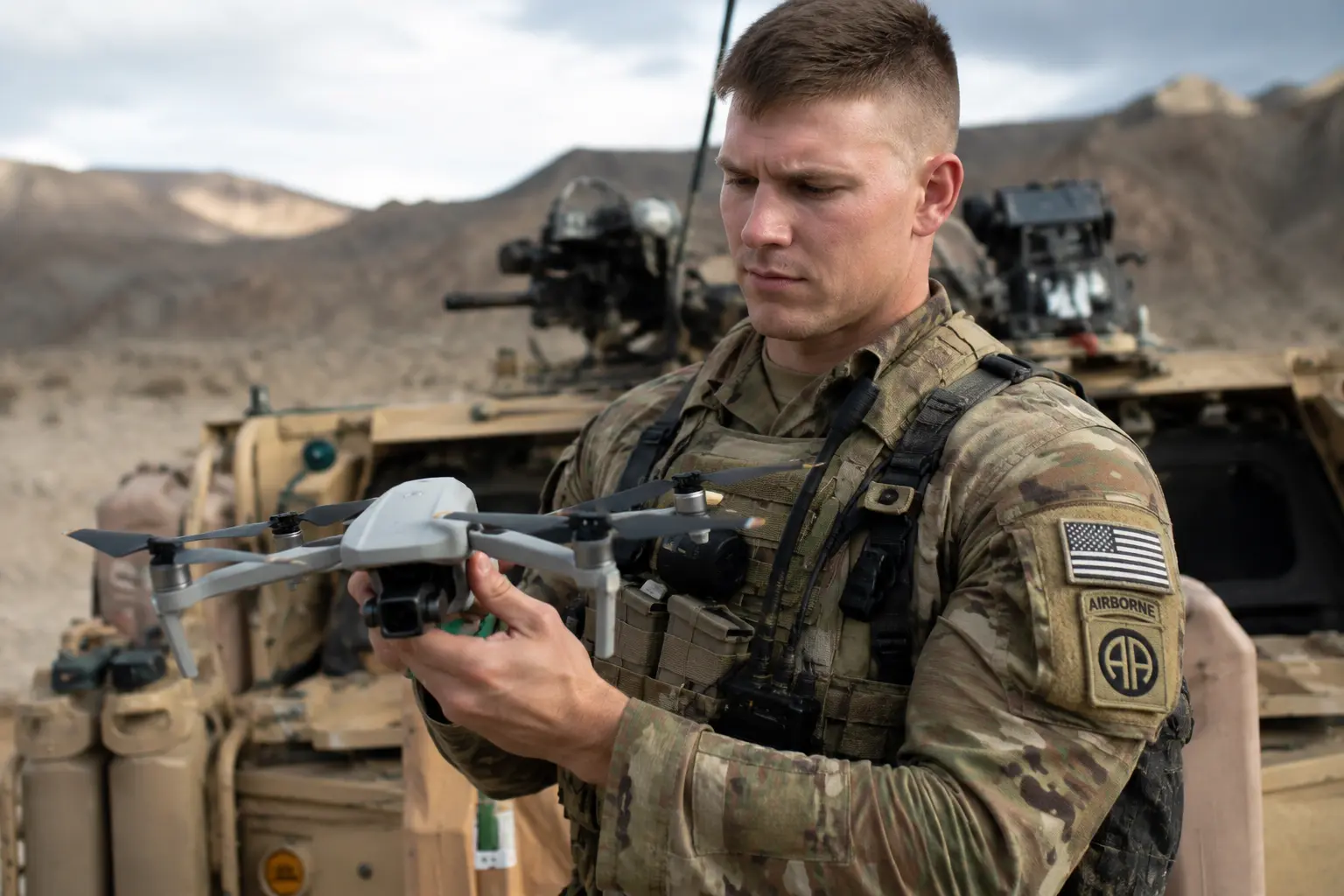
The Pentagon’s proposed $1.5 trillion defense budget contains $53.6 billion for the Defense Autonomous Warfare Group — and the domestic drone supply chain is already moving to absorb it.
The DAWG allocation breaks into two buckets: $39.2 billion for multi-year procurement of autonomous systems and domestic production capacity, and $14.4 billion for counter-UAS development and deployment. The procurement language specifically targets “unmanned systems across air, surface, subsurface, and ground domains from within the industrial base capacity” — a phrase that excludes foreign manufacturers and rewards companies that have built or are building US production lines.
Alongside the budget proposal, the DoD in April stood up the Autonomous Warfare Command under U.S. Southern Command, adding organizational infrastructure to match the funding ambition. The directive pairs with Trump’s June 2025 executive order requiring expedited domestic drone production and supply chain independence.
How the NDAA battery rules are reshaping sourcing
The fiscal year 2026 NDAA tightens one of the most overlooked choke points in drone manufacturing: battery cells. Starting January 1, 2028, the DoD cannot purchase batteries for weapons or support systems that use materials sourced from foreign entities of concern — a category that covers Chinese and Russian supply chains, which currently dominate lithium battery production globally.
Two companies disclosed moves directly tied to that deadline in recent weeks.
SES AI, a Boston-based battery developer, completed the conversion of its Chungju, South Korea facility in April to produce NDAA-compliant drone battery cells. The facility — originally built in 2021 under a joint development agreement with General Motors to manufacture EV battery cells — was repurposed after GM’s venture capital arm sold off its stake in November 2024. SES has a separate $150 million, five-year contract with the South Korean government for lithium metal battery manufacturing and R&D at the site. The company says it is using AI to optimize drone battery performance across temperature extremes, a capability relevant to combat deployments in environments ranging from Arctic cold to desert heat.
6K Energy and CRG Defense took a different approach: a seven-year supply agreement for domestic cathode active materials. Under the deal, 6K will supply CRG with single-crystal NMC811 cathode material — an 80/10/10 nickel-cobalt-manganese chemistry that prioritizes energy density — from its North Andover, Massachusetts facility. Additional supply will come from a new cathode active materials plant in Jackson, Tennessee, scheduled to come online in 2028, which aligns precisely with the NDAA compliance deadline.
Unusual Machines moves inventory ahead of demand
Unusual Machines took a different kind of action. The company announced it has initiated strategic purchase orders worth up to $75 million to secure materials and inventory across its drone component lines — a front-loaded supply chain bet designed to absorb demand spikes without lead time constraints.
CEO Allan Evans framed it as a capital deployment decision made possible by a recent fundraise: move early, secure supply, deliver at pace. The strategy is explicitly tied to the Trump executive order on domestic drone production. Unusual Machines, which sells drone components and manufactures FPV drones under the Rotor Riot brand, has positioned itself as a domestic alternative to Chinese component supply chains — a pitch that carries more weight with $53.6 billion in autonomous systems procurement now moving through Congress.
What the DAWG budget unlocks
The budget is still a proposal, not law. Congressional appropriations will determine what actually gets spent and where. But the directional signal is clear: the administration intends to spend at a scale that can genuinely restructure the US drone industrial base, not just fund incremental procurement.
For battery and component manufacturers, the 2028 NDAA compliance date is the near-term forcing function. Companies that have compliant supply chains in place before that deadline stand to capture contracts that currently go to foreign-sourced alternatives. For drone makers, the DAWG procurement language favors those manufacturing within the US industrial base — a requirement Unusual Machines and CRG Defense are both positioning to meet.
Congressional markup of the defense budget is expected to begin in the coming months. The final DAWG allocation and its specific program breakdowns will determine which platforms and which vendors actually benefit.