

Kraus Hamdani Aerospace
U.S. aerospace and autonomy company building long-endurance unmanned aircraft and communications-focused systems for defense and government missions.
1 article
Kraus Hamdani Aerospace
Kraus Hamdani Aerospace builds solar-electric long-endurance uncrewed aircraft for military ISR and communications relay. It was founded in 2016 by Stefan Kraus, chief technology officer, and Fatema Hamdani, chief executive. The company lists its head office in Reno, Nevada, with aircraft manufacturing in Hayward, California, electrical engineering in Fresno and aerospace engineering in Glasgow; press material from the company has also given a Californian corporate address. Customers are US military services, allied governments through Foreign Military Sales, and energy companies.
Products
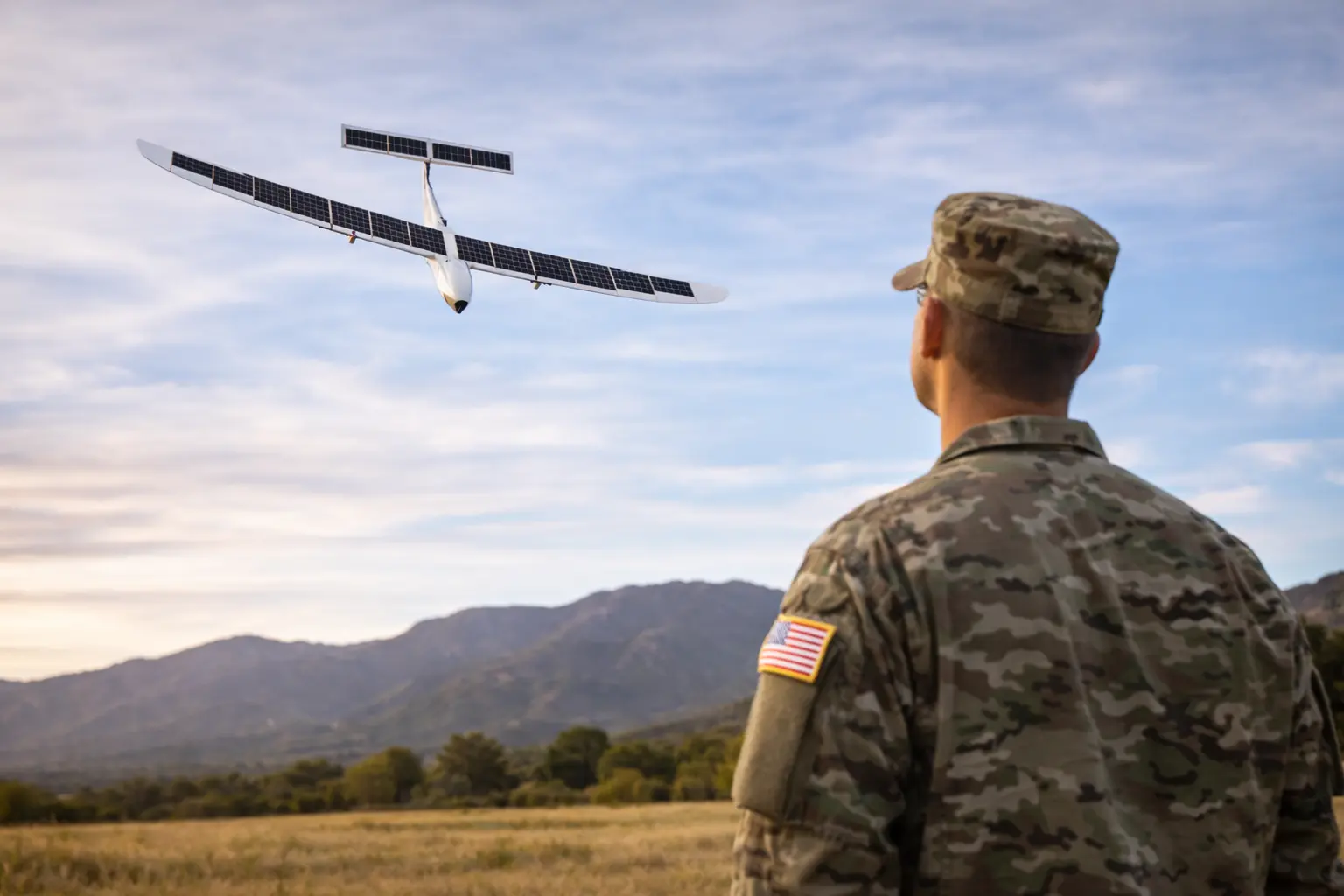
K1000ULE — the company’s single product line and the basis of its business. It is a fully electric Group 2 aircraft with a 20-foot wingspan and a takeoff weight of about 42.5 pounds, using solar panels and batteries for endurance. Reported figures include 75 hours of flight, more than 700 nautical miles of range and operation at 20,000 feet; the company holds a record flight of 75 hours 53 minutes set in 2023. It is carried by a two-person team and launches from a vehicle or vertically, with no runway or fuel logistics. The company says it flies AI-controlled soaring patterns modelled on bird flight, works in GPS-denied conditions, and can be operated as a swarm by a single operator.
ATNE++ — an airborne mesh network for voice and data bridging across legacy and modern tactical data links. MD-ACT — software for AI-assisted coordination of crewed and uncrewed platforms. Both are aimed at the relay-node role rather than the sensor role.
The company says its aircraft have flown more than 170,000 miles and 6,000 operational hours. Those are company figures.
Contracts and Position
Kraus Hamdani is private and does not disclose revenue or total funding. Its business is government contracts. In April 2026 US Air Forces Central awarded it a single-source IDIQ contract worth up to $270 million to accelerate K1000ULE deployment — an order of magnitude above its previous largest award, a roughly $20 million US Army contract in 2024. The Army, Navy and Marine Corps have bought the aircraft in smaller quantities since 2022, including for the 1st Multi-Domain Task Force, and the Navy procured it under PMA-263. In July 2026 the company announced delivery of K1000ULE systems to Panama’s Public Forces through a US Foreign Military Sale, described as multi-million-dollar with no figure released, alongside training to stand up Panama’s first drone squadron. Commercial work includes multi-year operations for Petroleum Development Oman. Breaking Defense has reported that the company supplies software to Ukrainian forces and updates its algorithms using operational data.
Why It Matters
The K1000ULE occupies a gap the US military discovered expensively: persistent overwatch and communications relay that does not require an MQ-9-class aircraft, a runway or a fuel chain. A 42-pound solar aircraft that stays up for three days is attritable in a way a Reaper is not, and AFCENT’s award followed a period of significant US drone losses to Iranian air defences.
The caveats are real. An IDIQ ceiling is not obligated money, and $270 million is what AFCENT may spend, not what it has. The company is effectively a single-platform business, and a 42-pound Group 2 airframe carries a small payload — it is a relay and a spotter, not a sensor truck. Scaling from roughly $20 million awards to a $270 million vehicle is a manufacturing problem the company has not yet had to solve at rate.
Coverage
Topics
Contracts
IDIQ contract for up to $270 million worth of K1000ULE solar-powered long-endurance scout drones for U.S. Air Forces...