
California-based DZYNE Technologies has unveiled Blitz, a Group 1 expendable attack drone designed for mass production and swarm deployment — entering a market the Pentagon is actively funding as cheap one-way attack platforms reshape how ground forces project firepower.
Blitz is electric-powered, weighs 6.8 kg, carries a 2.2 kg payload, and covers 80 to 150 km at speeds between 75 and 139 km/h with one to two hours of endurance. Its low acoustic and infrared signature from battery-electric propulsion delays detection — a meaningful tactical advantage against the kind of visual and thermal scanning that has become standard counter-drone practice along contested front lines.
How Blitz is designed for scale
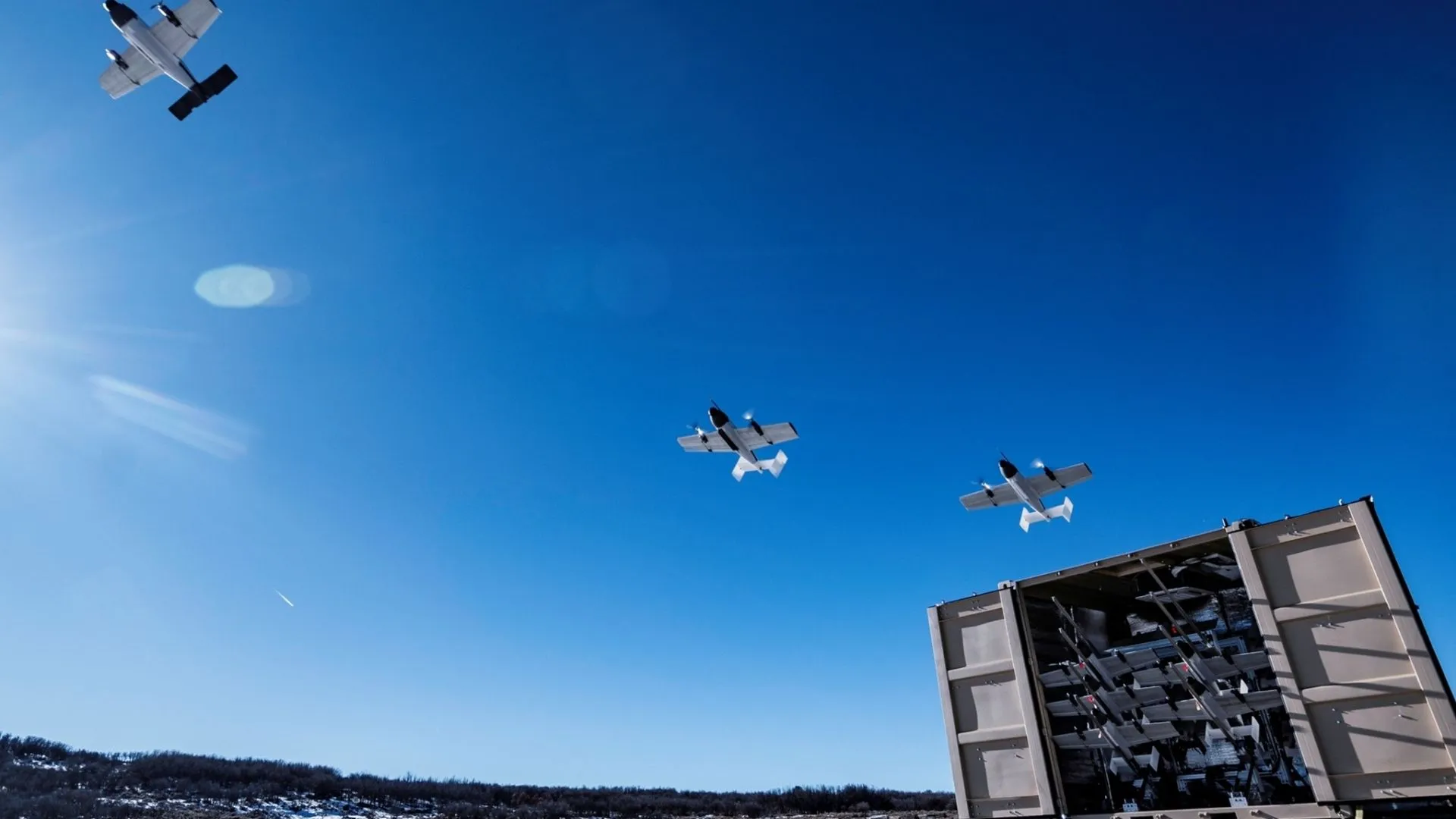
The platform is runway-independent. It can be hand-launched, rail-launched, or fired from BlitzBox — a standard ISO container that holds approximately 12 Blitz drones and functions as a self-contained swarm launcher. The same containerized launch logic underpins Anduril’s Barracuda-500M and reflects a broader shift in US procurement toward systems that move through ordinary logistics channels without a visible military signature.
Assembly takes under two minutes. The packed form factor — 755 × 947 × 175 mm — allows multiple units to be transported and deployed with minimal logistical overhead. Swappable nose, backpack payload bay, wingtip, and tail modules allow the same airframe to carry ISR sensors, electronic warfare payloads, decoys, or strike munitions, including third-party modules. A swappable battery extends the platform’s operational flexibility further.
The modular architecture is the design choice that matters most for production economics. A single airframe serving multiple mission types reduces the number of distinct platforms a unit needs to maintain, train on, and supply — the kind of operational simplicity that makes high-volume fielding tractable.
Where Blitz fits in DoD’s funding push
The US Department of War’s Drone Dominance Initiative, established to strengthen domestic drone manufacturing and arm combat units with low-cost attack platforms, continues in the FY2027 budget with $39.2 billion allocated for a multi-year investment in autonomous systems procurement and domestic production capacity. Blitz is positioned directly at that funding stream.
Group 1 drones — under 20 lbs, below 1,200 feet AGL, slower than 100 knots — have demonstrated disproportionate battlefield impact in Ukraine and the Iran conflict precisely because their radar cross-sections, typically between 0.01 and 0.1 square meters, make them difficult to detect and track with systems designed for larger threats. The proliferation of cheap commercial components and machine learning-driven autonomy has accelerated their capability curve faster than most counter-UAS development has kept pace.
DZYNE’s timing is deliberate. The DoD is running test buys across multiple low-cost munitions vendors in June 2026 as part of its Low-Cost Containerized Missiles program, and the Drone Dominance Initiative creates a parallel funding pathway for expendable Group 1 platforms. A drone that can be assembled in two minutes, launched from an ISO container, and produced at scale using commercially available components is the kind of system both programs are designed to buy.