
Skydio X10
A serious U.S.-made enterprise platform built around autonomy, sensors, and government-grade deployment rather than mass-market volume.
Skydio X10
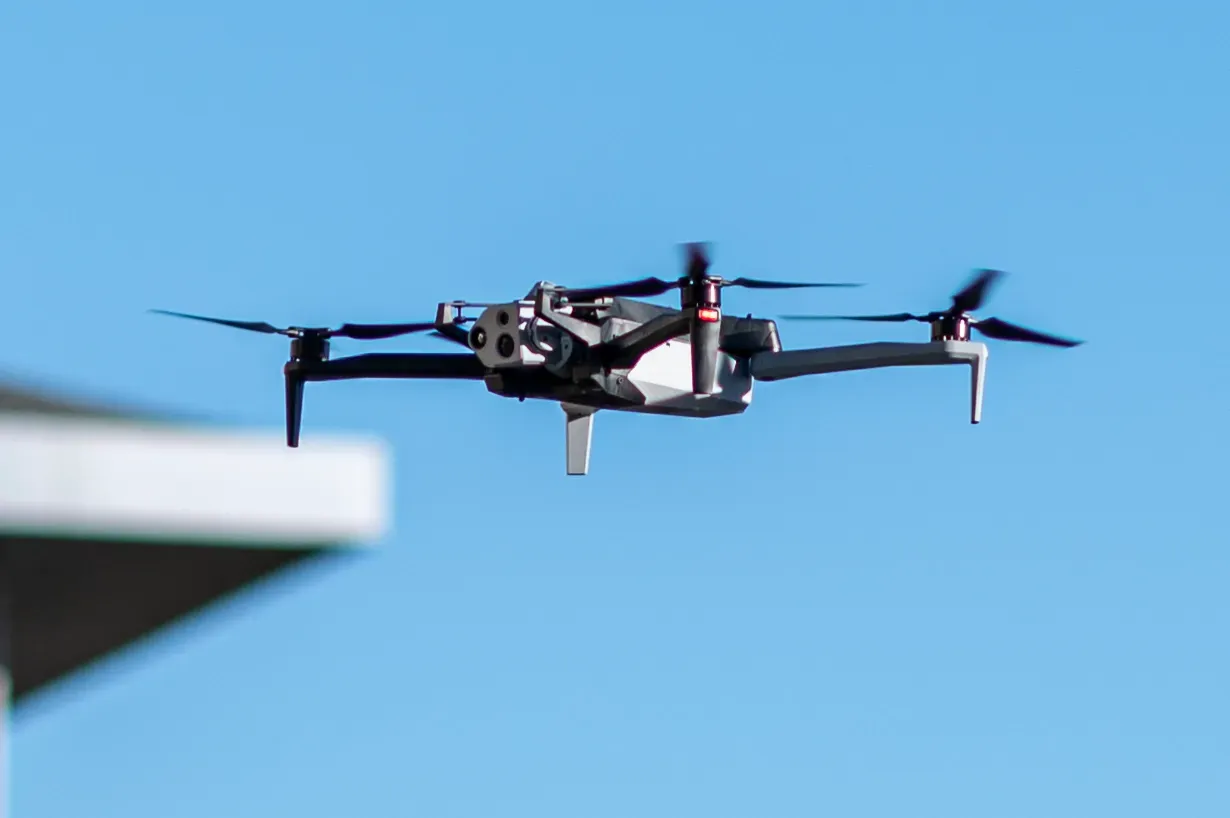
The Skydio X10 is Skydio’s flagship enterprise drone, released in 2024 as the successor to the X2 series. It is built around Skydio’s autonomous flight technology — obstacle avoidance and subject tracking that operates without manual pilot input — combined with a modular sensor payload targeting infrastructure inspection, public safety, and defense applications.
Skydio states the X10 is “fully NDAA-compliant and designed, assembled, and supported in the United States”, which is the reason most of its buyers are looking at it: it is one of a small number of enterprise platforms available to US federal purchasers. See the Blue UAS Cleared List guide for how that procurement route works.
Aircraft Specifications
| Specification | Skydio X10 |
|---|---|
| Weight | 2.11 kg / 4.65 lb (Connect SL, with batteries) |
| Weight with 5G | 2.14 kg / 4.72 lb |
| Max takeoff weight | 2.49 kg / 5.49 lb |
| Unfolded dimensions | 31.1 × 25.6 × 5.7 in |
| Folded dimensions | 13.8 × 6.5 × 4.7 in |
| Max flight time | Up to 40 minutes, depending on payload and conditions |
| Hover time | Approx. 35 minutes (lab conditions) |
| Wind resistance | Gusts up to 28 mph / 45 km/h |
| Ingress protection | IP55 |
| Obstacle avoidance | 360° omnidirectional, vision-based |
| Country of manufacture | United States |
Skydio does not publish a max horizontal speed or an operating temperature range in its public specifications, and neither figure is asserted here.
Sensor Payloads
The X10 takes one of two interchangeable payload packages rather than a fixed camera. Which one you buy determines what the aircraft is good for, and they are not equivalent.
| VT300-L | VT300-Z | |
|---|---|---|
| Wide camera | 50 MP wide-angle | — |
| Narrow camera | 64 MP | 64 MP |
| Telephoto | — | 48 MP zoom, approx. 128× system zoom |
| Thermal | Teledyne FLIR Boson+ radiometric | Teledyne FLIR Boson+ radiometric |
| Extra | Integrated LED flashlight | — |
| Best for | Close-range inspection and night work | Standoff observation and long-range identification |
The Boson+ is radiometric, meaning it measures temperature rather than only rendering relative heat, with sensitivity below 30 mK.
Connectivity
| Specification | Value |
|---|---|
| Primary radio | Connect SL, point-to-point, up to 7.5 miles / 12 km |
| Cellular | Connect 5G option |
Use Cases
Infrastructure inspection for utilities and telecoms, where Skydio’s autonomous inspection modes allow repeatable, georeferenced data capture without expert pilots. Law enforcement and public safety deployment, where subject tracking and autonomous flight reduce operator workload. US government and military ISR where NDAA compliance is a procurement requirement that eliminates most competing platforms.
Market Context
The X10 competes with the DJI Matrice 350 RTK in enterprise inspection workflows, but addresses a segment the Matrice cannot touch: US federal and defense procurement. DJI’s place on the FCC Covered List and its NDAA restrictions hand Skydio a protected lane in government sales, and much of the X10’s commercial position rests on that rather than on outperforming DJI on specification.
Against other NDAA-compliant platforms, the X10 is an inspection and observation aircraft rather than a tactical one. The Red Cat Black Widow is a different class of system — smaller, rucksack-carried, built for squad reconnaissance — and the two rarely compete for the same purchase. The honest trade-off against the Matrice is payload flexibility: DJI’s third-party payload ecosystem remains broader for private-sector multi-sensor workflows.
Verdict
A serious U.S.-made enterprise platform built around autonomy, sensors, and government-grade deployment rather than mass-market volume.