

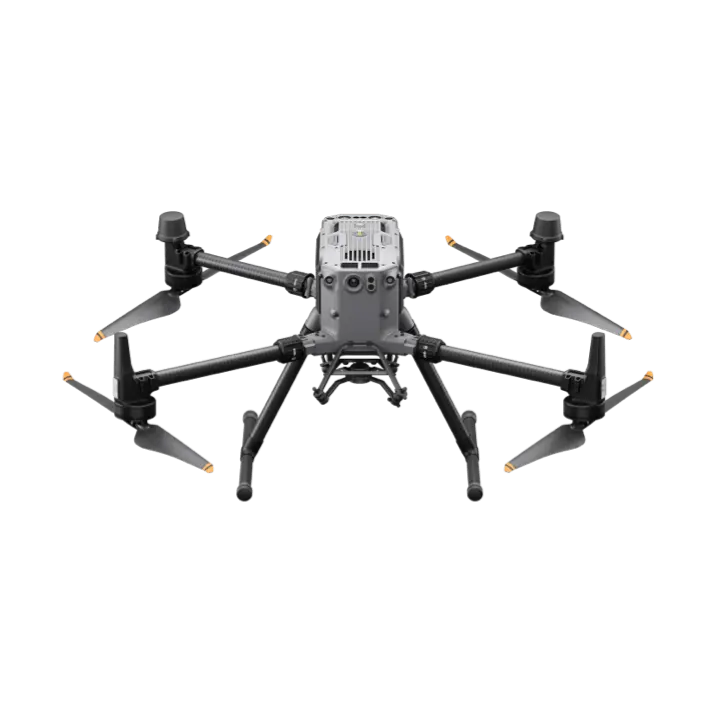
DJI Matrice 350 RTK
The benchmark enterprise inspection platform — IP55-rated, dual-operator capable, and compatible with the broadest payload ecosystem available, but off-limits for US federal government use under NDAA restrictions.
DJI Matrice 350 RTK
The DJI Matrice 350 RTK is a professional quadrotor drone built for industrial inspection, public safety, and enterprise mapping workflows. It is the successor to the Matrice 300 RTK. DJI has since introduced the Matrice 400 above it, so the 350 RTK is no longer the top of the enterprise line, though it remains the volume platform. It is designed around extended field operations, with hot-swappable batteries and a 55-minute maximum flight time, and it targets utility companies, survey firms, search and rescue agencies, and infrastructure operators.
Aircraft Specifications
| Specification | DJI Matrice 350 RTK |
|---|---|
| Max takeoff weight | 9.2 kg |
| Single gimbal max payload | 960 g |
| Unfolded dimensions | 810 × 670 × 430 mm, without propellers (L×W×H) |
| Folded dimensions | 430 × 420 × 430 mm, with propellers (L×W×H) |
| Max flight time | 55 minutes, without payload in windless conditions |
| Max horizontal speed | 23 m/s |
| Service ceiling | 5,000 m (standard propellers) / 7,000 m (high-altitude propellers) |
| Max wind resistance | 12 m/s |
| Operating temperature | −20 °C to 50 °C |
| Ingress protection | IP55 |
| GNSS | GPS + GLONASS + BeiDou + Galileo |
| RTK accuracy | 1 cm + 1 ppm horizontal, 1.5 cm + 1 ppm vertical |
| Obstacle sensing | 0.7–40 m forward, backward, left and right; 0.6–30 m up and down |
On payload capacity. DJI’s specification page publishes a 960 g maximum for a single gimbal damper and a 9.2 kg maximum takeoff weight. A 2.7 kg total payload figure circulates widely and appeared on this page previously; it is not on DJI’s published specification page and is not asserted here. If payload margin is the deciding factor in a purchase, get the figure for your exact configuration from the dealer in writing.
Battery and Transmission
| Specification | Value |
|---|---|
| Battery model | TB65 (hot-swappable, dual battery system) |
| Battery capacity | 5,880 mAh at 44.76 V |
| Battery energy | 263.2 Wh |
| Transmission system | DJI O3 Enterprise |
| Max range (FCC) | 20 km |
| Max range (CE/SRRC/MIC) | 8 km |
The aircraft supports simultaneous payloads across upward and downward gimbal ports plus an FPV camera, and DJI markets dual-operator control, letting one operator fly while a second works the sensors independently. Supported gimbals include the H30 and H20 series, the L-series LiDAR units, P1, S1 and V1.
Use Cases
Power line and pipeline inspection, where RTK positioning and thermal payload compatibility allow precise georeferenced data capture. Search and rescue, where dual-operator mode lets a pilot fly while a second operator manages sensors. Photogrammetry and survey mapping for construction progress, mining volumetrics, and land survey.
Pricing
Dealer pricing for the airframe alone starts around $11,000 and runs higher depending on territory and reseller, with authorised dealers listing figures into the $13,000 range. A full working system costs considerably more: adding a payload roughly doubles the outlay, and spare TB65 batteries and DJI Care coverage add several thousand on top. Treat the airframe figure as a floor rather than a purchase price.
Market Context
The Matrice 350 RTK is the most widely deployed enterprise inspection platform globally by installed base. Its primary Western competitors are the Autel EVO Max 4T and the Freefly Alta X, neither of which matches its payload ecosystem breadth.
The Skydio X10 is the relevant comparison for anyone who cannot buy DJI: it is built around autonomous inspection rather than payload versatility, and it is the platform that inherits these workflows in US federal settings. Within DJI’s own line, the Mavic 3 Enterprise is the portable alternative, trading payload flexibility and the IP55 rating for size and price.
The Matrice 350 RTK is not NDAA compliant — DJI is on the FCC Covered List and the DoD’s Section 1260H list — which excludes it from US federal government and military procurement. See the Blue UAS Cleared List for what is eligible instead. For private-sector enterprise use, this restriction does not apply.
Verdict
The benchmark enterprise inspection platform — IP55-rated, dual-operator capable, and compatible with the broadest payload ecosystem available, but off-limits for US federal government use under NDAA restrictions.
Made by DJI
Recent Coverage
When you buy through links on this page we may earn an affiliate commission. As an Amazon Associate FlightBrief earns from qualifying purchases. It costs you nothing extra, and it does not influence our editorial assessment — see our editorial policy.