

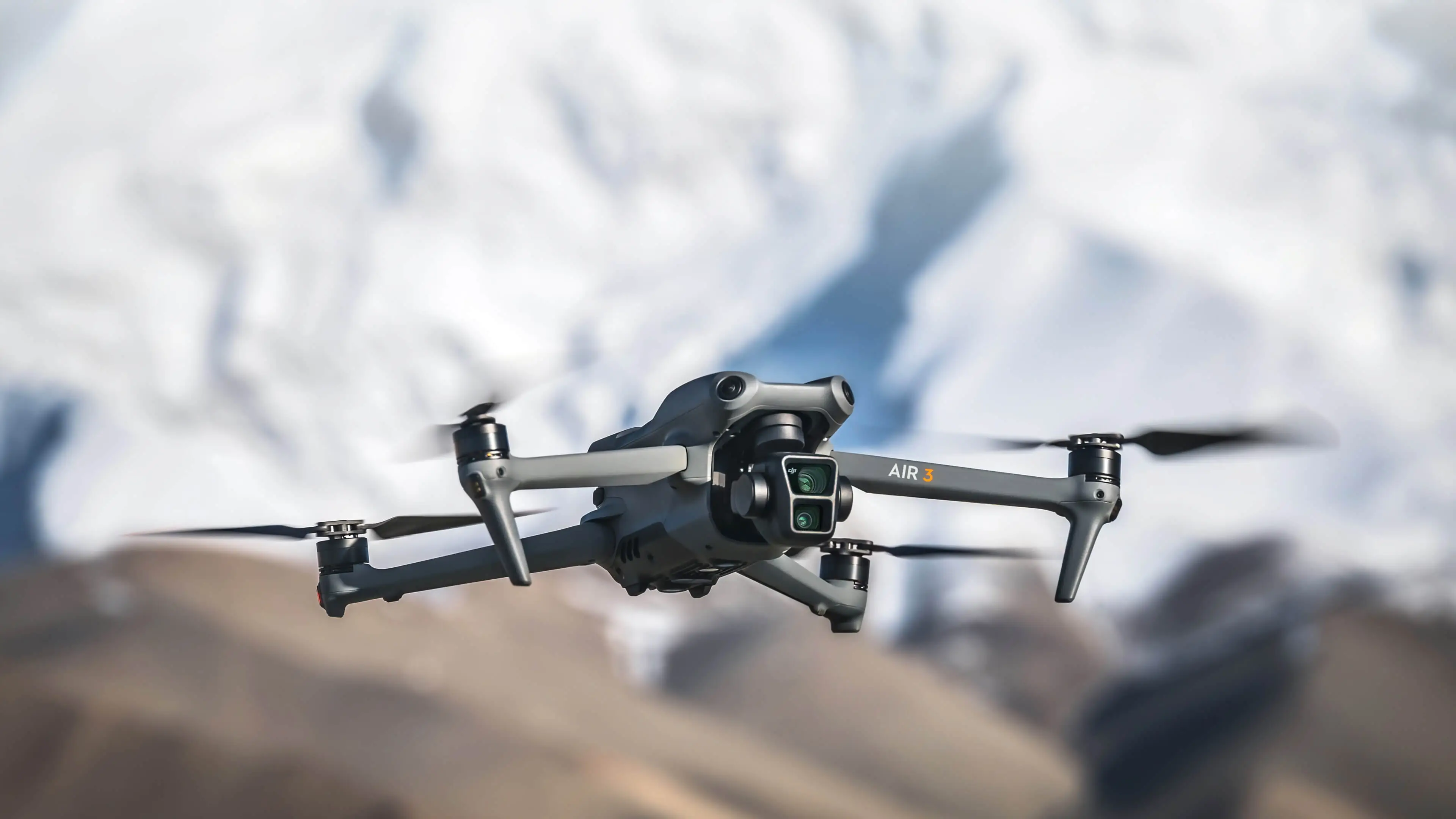
DJI Air 3
A dual-camera mid-range drone that covers most shooting scenarios for enthusiast creators, sitting cleanly between the Mini 4 Pro and Mavic 3 Pro in capability and price.
DJI Air 3
The DJI Air 3 is a mid-range folding drone with a dual-camera system, released in July 2023. It targets enthusiast creators and prosumers who want more than a single fixed lens but do not need the Mavic 3 Pro’s three-camera system or price tag. The Air series sits between the Mini and Mavic lines in DJI’s consumer lineup.
It weighs 720 g, which is above the 250 g threshold, so it requires FAA registration for recreational flight in the United States.
Aircraft Specifications
| Specification | DJI Air 3 |
|---|---|
| Takeoff weight | 720 g |
| Folded dimensions | 207 × 100.5 × 91.1 mm (L×W×H) |
| Unfolded dimensions | 258.8 × 326 × 105.8 mm (L×W×H) |
| Max flight time | 46 minutes |
| Max hovering time | 42 minutes |
| Max horizontal speed | 21 m/s (19 m/s in the EU) |
| Max ascent speed | 10 m/s |
| Max descent speed | 10 m/s |
| Max takeoff altitude | 6,000 m |
| Max wind resistance | 12 m/s |
| Operating temperature | −10 °C to 40 °C |
| GNSS | GPS + Galileo + BeiDou |
| Internal storage | 8 GB |
| Expandable storage | microSD |
Payload Capacity
DJI publishes no payload capacity for the Air 3, and the aircraft has no official payload mount or release accessory. The gimbal is fixed and the cameras are not interchangeable. Anyone who needs a drone that carries a payload should be looking at the enterprise line — the Matrice 350 RTK — rather than at the Air series.
Battery
| Specification | Value |
|---|---|
| Capacity | 4,241 mAh |
| Energy | 62.6 Wh |
| Type | Li-ion 4S |
| Nominal voltage | 14.76 V |
| Charging time | Approx. 80 minutes (65 W) / 60 minutes (100 W) |
Camera Specifications
Both cameras use the same sensor. The difference between them is the lens, so image quality is more consistent across focal lengths here than it is on the Mavic 3 Pro, where the three sensors differ.
| Specification | Wide-angle | Medium tele |
|---|---|---|
| Sensor | 1/1.3-inch CMOS | 1/1.3-inch CMOS |
| Effective pixels | 48 MP | 48 MP |
| Aperture | f/1.7 | f/2.8 |
| Focal length (35mm eq.) | 24 mm | 70 mm |
| Max photo resolution | 8064 × 6048 | 8064 × 6048 |
| Specification | Value |
|---|---|
| Video (4K) | 3840 × 2160 @ 24/25/30/48/50/60/100fps |
| Video (FHD) | 1920 × 1080 @ 24/25/30/48/50/60/100/200fps |
| Max video bitrate | 150 Mbps (H.264/H.265) |
| Video ISO | 100–6400 |
| Photo ISO | 100–6400 (12 MP) / 100–3200 (48 MP) |
Transmission and Obstacle Sensing
| Specification | Value |
|---|---|
| Transmission system | O4 |
| Max range (FCC) | 20 km |
| Max range (CE/SRRC/MIC) | 10 km |
| Live view quality | 1080p/30fps, 1080p/60fps |
| Obstacle sensing | Omnidirectional binocular vision, plus an infrared sensor |
Use Cases
Travel videography and photography where the 720 g weight matters for airline carry-on limits and hiking. Real estate and event videography at the prosumer level. Enthusiast aerial photography where a single focal length feels limiting but the Mavic 3 Pro’s price is hard to justify.
Market Context
The Air 3 is the first Air-series drone with a dual-camera setup, closing a meaningful gap with the Mavic line.
It is worth being precise about how it compares to the cheaper Mini 4 Pro, because the wide cameras are closely matched: both are 1/1.3-inch 48 MP sensors at f/1.7 and 24 mm equivalent. The Air 3’s advantages are elsewhere — the second 70 mm camera, 46 minutes of flight time against the Mini’s 34 on the standard battery, and 12 m/s wind resistance against 10.7 m/s. Both use O4 transmission. What the Mini 4 Pro buys instead is its sub-249 g takeoff weight, which keeps it under the FAA registration threshold for recreational flight. If that threshold matters to you, it outweighs everything above.
Against the Autel EVO Nano+ and Lite+, the Air 3’s O4 transmission and DJI’s obstacle avoidance implementation are more mature.
DJI’s federal regulatory status applies here as with all DJI products: the company is on the FCC Covered List and faces NDAA restrictions for federal government use. The Air 3 is a civilian consumer product and is not eligible for federal procurement. Agencies buying under NDAA rules should start from the Blue UAS Cleared List.
Successor
DJI has since released the Air 3S, which supersedes the Air 3 in the current lineup. The 3S moves the wide camera to a 1-inch sensor and adds forward LiDAR for low-light obstacle sensing. The Air 3 remains available at a lower price and is still a capable platform, but anyone buying new should compare the two before deciding; the price gap is often smaller than the specification gap.
Verdict
A dual-camera mid-range drone that covers most shooting scenarios for enthusiast creators, sitting cleanly between the Mini 4 Pro and Mavic 3 Pro in capability and price.
Made by DJI
Recent Coverage
When you buy through links on this page we may earn an affiliate commission. As an Amazon Associate FlightBrief earns from qualifying purchases. It costs you nothing extra, and it does not influence our editorial assessment — see our editorial policy.