
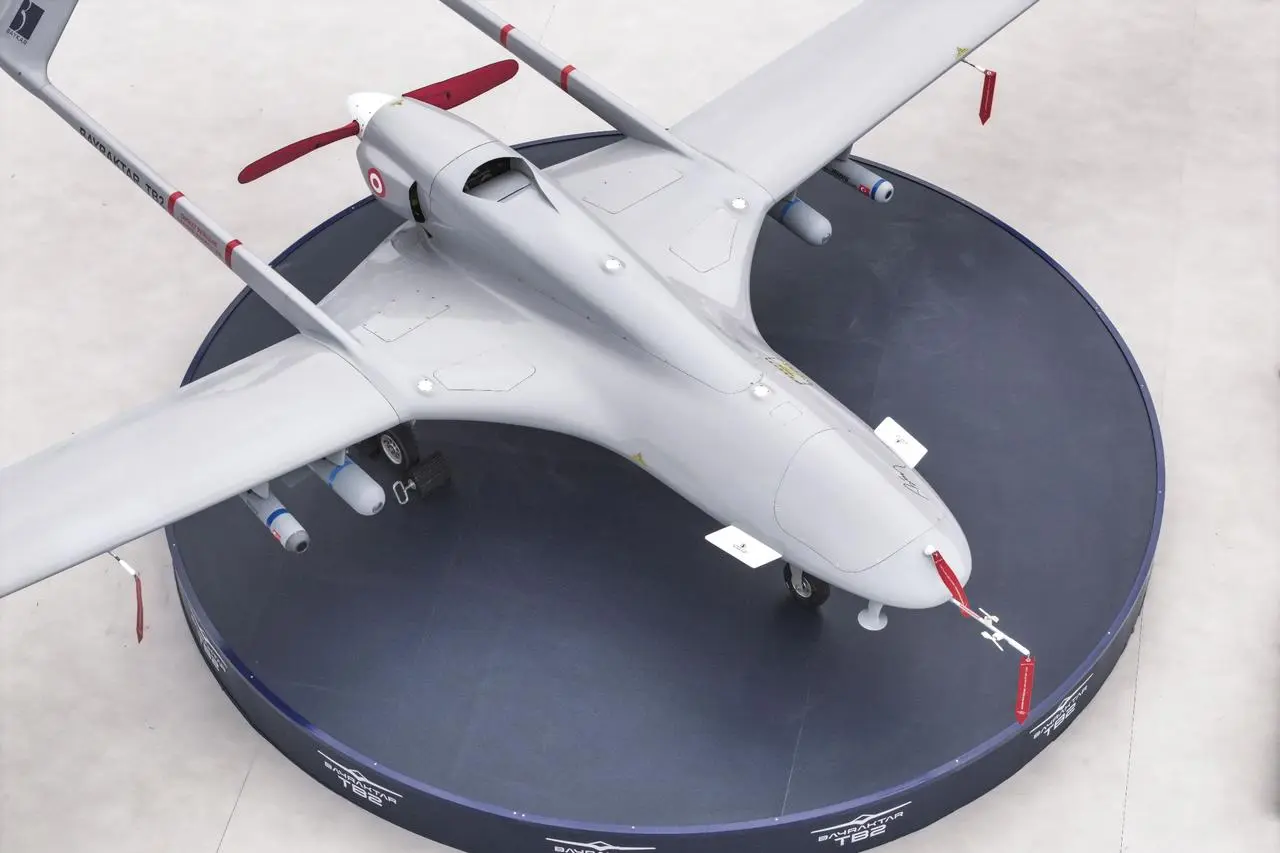
French defense electronics firm Safran and Turkish drone maker Baykar signed a strategic partnership on Tuesday to integrate Safran’s optronic sensors, navigation systems, and guided munitions capabilities into Baykar’s unmanned platforms — most immediately the TB2, which will swap its Canadian L3Harris Wescam MX-15 system for Safran’s Euroflir optronic suite.
The deal is the most concrete sign yet that Franco-Turkish defense-industrial relations are recovering from a period of open hostility. As recently as November 2024, French Chief of Defense Staff Gen. Thierry Burkhard had placed Ankara on a list of France’s “strategic competitors” alongside Moscow, Beijing, and Tehran. The Safran-Baykar agreement did not emerge from a diplomatic vacuum — a French Senate report weeks after that statement called for deeper bilateral military cooperation, and operational contacts between the two militaries have quietly resumed.
What the partnership actually covers
The joint statement described co-development of “integrated solutions combining optronic sensors, navigation systems and guided armament capabilities, intended for both drone platforms and air-to-ground operations.” For the TB2 specifically, Safran’s Euroflir systems replace the MX-15 — a change that French defense publication Zone Militaire described as significantly enhancing the platform’s surveillance, reconnaissance, and targeting capabilities.
The Euroflir range is Safran’s primary airborne electro-optical and infrared sensor family, used across French military aviation including the Rafale. Integrating it into the TB2 gives Baykar a sensor package with NATO interoperability credentials and a European supply chain — relevant for export markets where Canadian components have faced licensing complications or political friction.
Both companies made the commercial dimension explicit. They committed to jointly promoting co-developed solutions to international clients, which signals this is not a one-platform integration but the foundation of a broader export strategy targeting third countries looking for European-pedigreed drone capabilities.
The Greece problem
Zone Militaire flagged the complication Safran is now managing: Greece has ordered Safran’s Patroller tactical drone and participates in the Rafale consortium’s economic interest group. Safran now has significant defense-industrial relationships with two NATO allies that hold competing territorial claims in the Eastern Mediterranean. Athens will notice that the same French sensor technology it operates is being integrated into Turkish platforms that Turkey has previously deployed in Libya and sold to countries across the Middle East, Africa, and Central Asia.
Whether that creates political friction depends on how aggressively Baykar markets the upgraded TB2 and to whom. The TB2’s export record — more than 30 countries — means the Euroflir integration will eventually appear in operational contexts France cannot fully control. That is the implicit trade Safran has accepted in exchange for access to Baykar’s production volumes and customer base.