
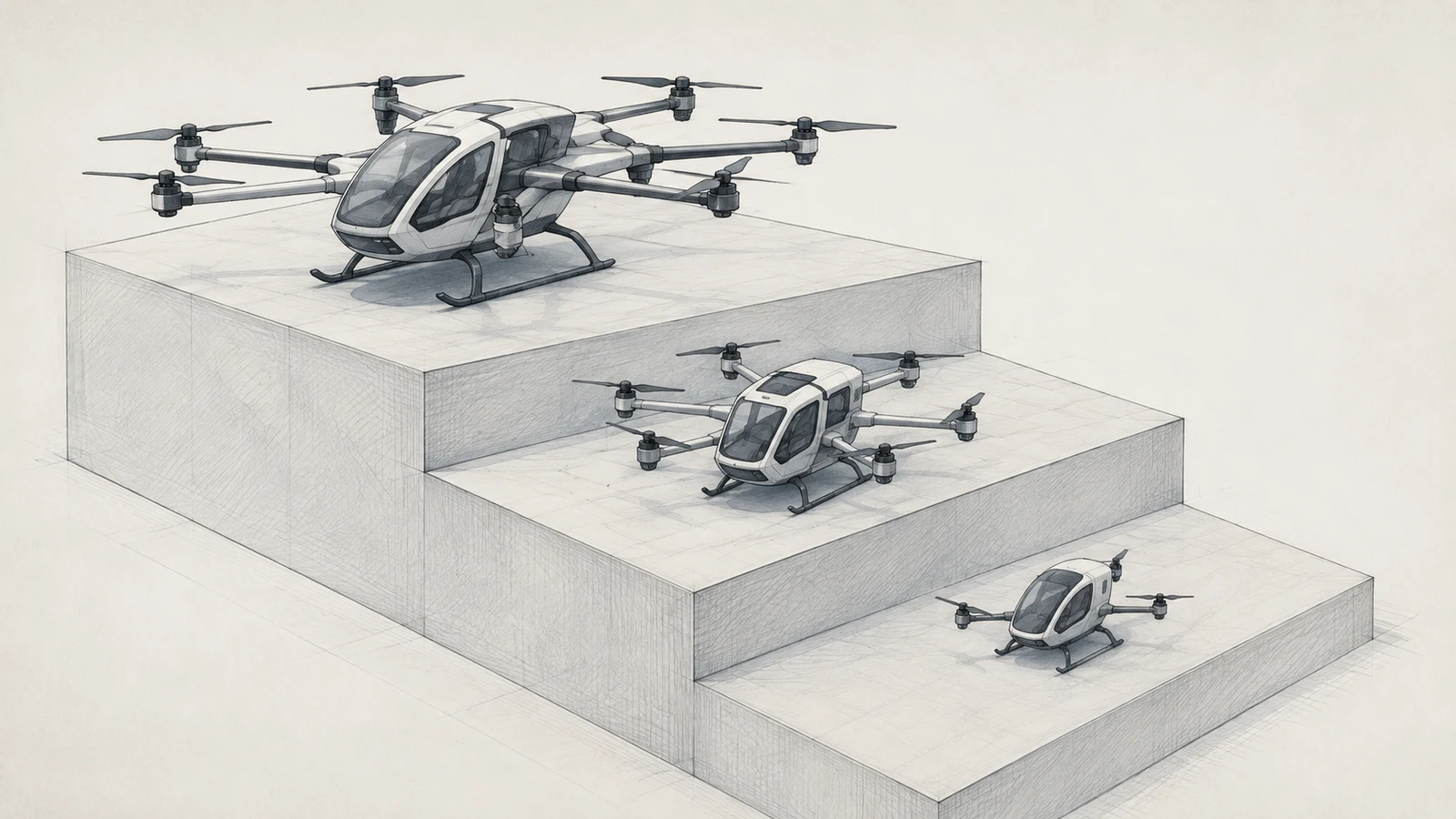
Volocopter was going to fly passengers over the 2024 Paris Olympics. Its first product under new ownership is a two-seat ultralight with a 40-kilometre range, sold to flying clubs and sightseeing operators.
The company launched the VoloXPro in April: 18 rotors, 70 km/h cruise, 600 kg maximum takeoff weight, 154 kg payload. It is going through the German ultralight category, not EASA type certification, with approval and market entry targeted for the end of 2026. It reuses VoloCity components, which is how the engineering survives even though the market does not. The VoloCity itself is still in work, with type certification now expected in 2027.
That is what came out of insolvency. Volocopter filed in December 2024 after missing the Olympics, and in March 2025 its assets went to China’s Wanfeng Auto Holding Group through the Austrian manufacturer Diamond Aircraft, in a deal reported at around €10 million against assets valued near €42 million. Just over 180 of roughly 500 staff were kept. Ultralight certification is a real product and a genuine achievement. It is not what €590 million was raised to build.
Supernal has gone further backwards. Hyundai paused development in late summer 2025 after CEO Jaiwon Shin and CTO David McBride both left, and in February the company laid off 296 people — about 80% of staff — across Irvine, Fremont and the Mojave Air & Space Port, leaving 70 to 80. There has been no permanent chief executive since. The S-A2 tilt-rotor unveiled at CES in 2024 is explicitly no longer the product; Supernal says it will be used to refine design guides as it moves to a next-generation aircraft. In May, Hyundai and Korea Aerospace Industries signed a memorandum of understanding to build something together, with no timeline, funding figure or hiring commitment disclosed. The original 2028 target has no replacement.
Vertical Aerospace kept its aircraft and lost its equity. The VX4 became the Valo in December, targeting four passengers over 100 miles and service entry in 2028, and the company flew five consecutive days at Farnborough with a Critical Design Review due by year end. In April it closed a financing package of up to $850 million with Mudrick Capital Management and Yorkville Advisors, against an estimated $700 million cost of certifying the aircraft. Immediate working capital after a $50 million equity raise was about $160 million. The market capitalisation is roughly $103 million and the shares trade near $0.60. An $850 million facility against a company worth $103 million funds the aeroplane by diluting the shareholders, and both of those are true at once.
None of this means eVTOL is failing. All three programmes are alive, and Volocopter will probably certify something this year, which is more than Joby or Archer can say. What shrank is the promise. Urban air mobility was sold as thousands of aircraft running city-scale networks on ride-hailing economics. What survived is a trainer, a requirements document and a regional aircraft financed on terms that treat its shareholders as the least important party — which is the same thing the delivery side of this industry found out this year. Certification is slow and expensive and it is not the binding constraint. Money is.