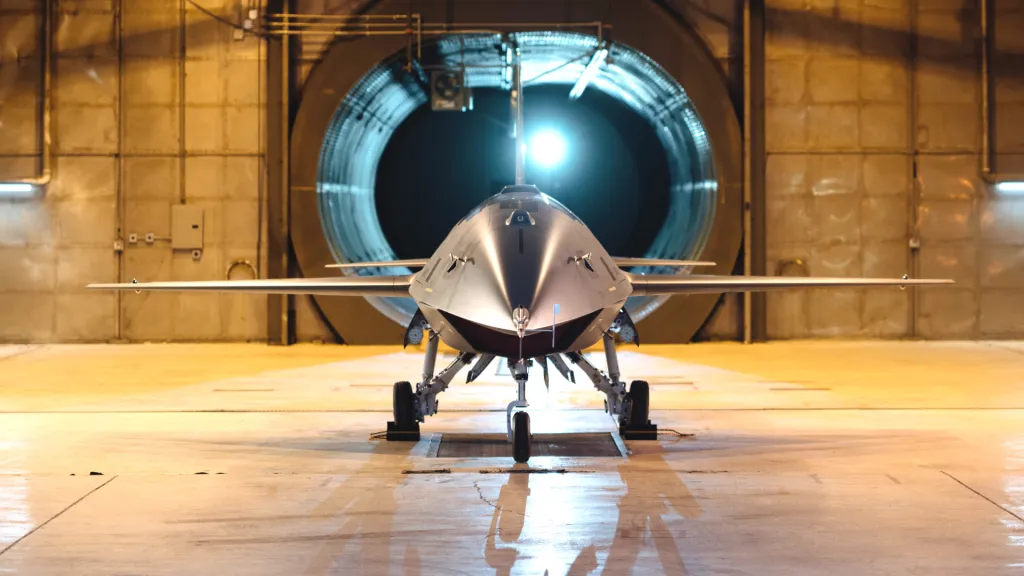
Six months after its first semi-autonomous flight, Anduril’s YFQ-44A Fury has passed a more consequential milestone: U.S. Air Force personnel ran the aircraft themselves, without Anduril employees present, conducting daily sorties at Edwards Air Force Base from a ground setup that fit into two Pelican cases and a laptop.
The exercise was led by the Air Force’s newly stood-up Experimental Operations Unit — the organization specifically responsible for developing the doctrine, tactics, and procedures that will govern how Collaborative Combat Aircraft are integrated and deployed ahead of future combat operations. Its involvement marks the formal beginning of the handoff from contractor-led testing to Air Force-led experimentation, and it arrived less than two years after Anduril received the prototype contract award.
What the EOU actually did
For the duration of the exercise, EOU operators assumed full operational control of the YFQ-44A after the aircraft flew from Anduril’s Southern California test site to Edwards. Air Force personnel handled launch, recovery, pre- and post-flight checks, weapons loading and unloading, and direct tasking during taxi and flight. When the exercise concluded, the YFQ-44A returned to the Southern California facility. Anduril was not running the aircraft.
The ground element was Anduril’s Menace-T command, control, communications, and compute system — a ruggedized laptop through which EOU operators uploaded mission plans, initiated autonomous taxi and takeoff, tasked the aircraft while airborne, and managed post-flight data. The entire operational footprint fit into two Pelican cases. That is a deliberate design outcome, not an incidental one. The CCA program has been built from the outset around the Air Force’s Agile Combat Employment concept, which calls for dispersing aircraft and personnel across multiple small, flexible locations to reduce vulnerability in contested environments. A combat aircraft that requires a large logistics tail to operate cannot support ACE. One that can be sustained from a simulated forward operating base by a small crew with days of training can.
Maintainers assigned to the EOU successfully turned the YFQ-44A between sorties throughout the exercise with minimal training. Automated software checks were cited as a key factor in reducing manpower requirements, alongside the aircraft’s intentionally simplified hardware design. Traditional unmanned aerial vehicles typically require substantially larger ground crews and more extensive training pipelines. The EOU exercise was a direct challenge to that assumption, and the YFQ-44A passed it.
Why front-loading autonomy mattered
Anduril made a deliberate bet early in the program: make all taxi and flight tests semi-autonomous from the outset, even at the cost of delaying some early milestones. The logic was that front-loading autonomy would accelerate the program’s long-term trajectory by ensuring the software architecture was mature before Air Force operators ever touched the aircraft.
The EOU exercise was the first real-world validation of that approach. Operators were able to run the aircraft with minimal training precisely because the autonomy stack was not bolted on after the fact — it was the foundation the program was built on. Six months from first flight to independent Air Force operations is a pace that most major defense aircraft programs cannot match, and Anduril has been explicit that the early investment in autonomous architecture is the reason.
The lessons gathered during the exercise are expected to feed directly back into both future EOU exercises and ongoing development of the aircraft. Additional exercises will continue evaluating the YFQ-44A’s relevance to ACE concepts and generating the operational data needed to refine CCA doctrine and workflows.
The competition
The YFQ-44A is one of two aircraft competing for the Air Force’s Collaborative Combat Aircraft program. Boeing is developing the YFQ-42A under a separate contract, making this a competitive prototype phase with two distinct platforms vying to define the future of autonomous American airpower. The Air Force has described the CCA program as a generational shift in how American airpower will be projected — the goal is a combat-ready capability by the end of the decade, faster than any major fighter program in more than 50 years.
The CCA concept pairs autonomous or semi-autonomous unmanned aircraft with crewed fighters to extend sensor reach, carry weapons, absorb risk, and complicate an adversary’s targeting picture. The Air Force has stated a requirement for more than 1,000 aircraft, which makes the production contract one of the most significant drone procurements currently underway anywhere in the world.
For Anduril, the EOU exercise is the strongest signal yet that the YFQ-44A is on track. A program that reaches independent Air Force operations six months after first flight — with a two-Pelican-case ground footprint and maintainers trained in days — is making a credible argument that autonomous combat aircraft do not have to be as complex or as expensive to operate as the legacy systems they are designed to replace. Whether that argument holds at scale, across dispersed forward bases in a contested environment, is what the next round of exercises will determine.