
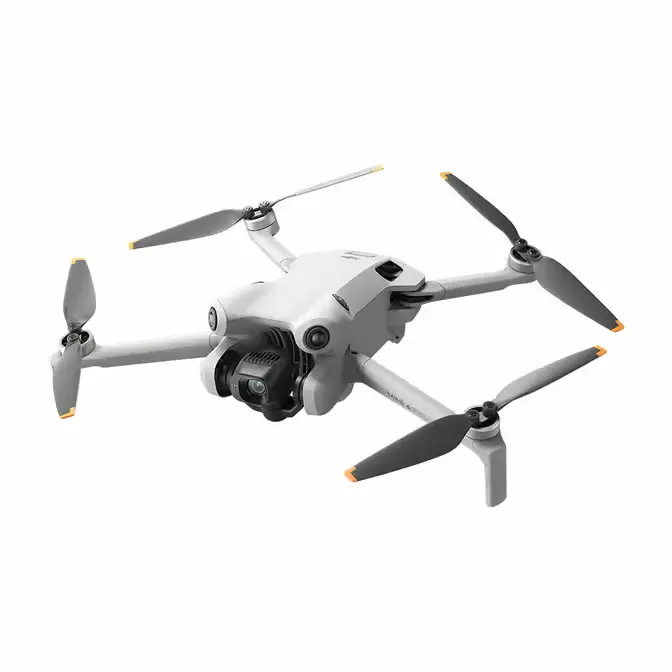
DJI Mini 4 Pro
The most capable sub-250g drone available, and the right choice for anyone who wants serious image quality without triggering registration requirements in most markets.
DJI Mini 4 Pro
The DJI Mini 4 Pro is a folding consumer drone with a takeoff weight under 249 g — just below the 250 g threshold that triggers drone registration requirements in the US, EU, UK, and most other markets. Released in September 2023, it is the first Mini-series drone with omnidirectional obstacle avoidance and the first to support vertical 4K video natively. It targets casual consumers, travellers, and creators who want to fly legally with minimal regulatory friction.
The Plus battery breaks the weight exemption. DJI’s own specification notes that takeoff weight exceeds 249 g when the Intelligent Flight Battery Plus is fitted. The 45-minute flight time everyone quotes comes from that battery, so the headline endurance and the sub-250 g status cannot both be true on the same flight. Fly the standard battery if the threshold is why you bought it.
Aircraft Specifications
| Specification | DJI Mini 4 Pro |
|---|---|
| Takeoff weight | < 249 g (standard battery); over 249 g with Plus battery |
| Folded dimensions | 148 × 94 × 64 mm (L×W×H) |
| Unfolded dimensions | 298 × 373 × 101 mm (L×W×H) |
| Max flight time | 34 minutes (standard) / 45 minutes (Plus) |
| Max hovering time | 30 minutes (standard) / 39 minutes (Plus) |
| Max horizontal speed | 16 m/s (Sport) / 12 m/s (Normal and Cine) |
| Max ascent speed | 5 m/s (Sport and Normal) / 3 m/s (Cine) |
| Max descent speed | 5 m/s (Sport and Normal) / 3 m/s (Cine) |
| Service ceiling | 4,000 m (standard) / 3,000 m (Plus) |
| Max wind resistance | 10.7 m/s |
| Operating temperature | −10 °C to 40 °C |
| GNSS | GPS + Galileo + BeiDou |
| Internal storage | 2 GB |
| Expandable storage | microSD |
Battery
| Specification | Standard | Plus |
|---|---|---|
| Capacity | 2,590 mAh | 3,850 mAh |
| Energy | 18.96 Wh | 28.4 Wh |
Camera
| Specification | Value |
|---|---|
| Sensor | 1/1.3-inch CMOS |
| Effective pixels | 48 MP |
| Aperture | f/1.7 |
| Focal length (35mm eq.) | 24 mm |
| Max photo resolution | 8064 × 6048 |
| Video (4K) | 3840 × 2160 @ 24/25/30/48/50/60/100fps |
| Video (FHD) | 1920 × 1080 at multiple frame rates |
| Max video bitrate | 150 Mbps |
| Photo ISO | 100–6400 (12 MP) / 100–3200 (48 MP) |
Transmission and Obstacle Sensing
| Specification | Value |
|---|---|
| Transmission system | O4 |
| Max range (FCC) | 20 km |
| Max range (CE) | 10 km |
| Obstacle sensing | Omnidirectional binocular vision, plus a 3D infrared sensor |
Use Cases
Travel photography where sub-250 g weight avoids registration requirements and reduces gear burden. Casual consumer use for family events, property photography, and social content. Entry-level real estate photography where 4K and a decent sensor are sufficient and budget matters.
Market Context
The Mini 4 Pro has no serious direct competitor at sub-250 g with omnidirectional obstacle sensing. The Autel EVO Nano+ is comparable on weight but uses a smaller sensor and lacks equivalent obstacle avoidance.
Against DJI’s own Air 3, the comparison is closer than the price gap suggests: both use a 1/1.3-inch 48 MP sensor at f/1.7 and 24 mm equivalent, and both use O4 transmission. What the Air 3 adds is a second 70 mm camera, longer endurance and better wind resistance; what the Mini 4 Pro keeps is the weight exemption. If the 250 g threshold matters in your market, that outweighs the rest.
DJI’s US regulatory status does not affect civilian consumer use, but the company is on the FCC Covered List and the Mini 4 Pro is not eligible for federal procurement. Agencies should start from the Blue UAS Cleared List.
Verdict
The most capable sub-250g drone available, and the right choice for anyone who wants serious image quality without triggering registration requirements in most markets.
Made by DJI
Recent Coverage
When you buy through links on this page we may earn an affiliate commission. As an Amazon Associate FlightBrief earns from qualifying purchases. It costs you nothing extra, and it does not influence our editorial assessment — see our editorial policy.