
Lucid Bots
US commercial robotics company producing the Sherpa exterior building cleaning drone and the Lavo ground cleaning robot, sold to commercial cleaning operators.
1 article
Lucid Bots
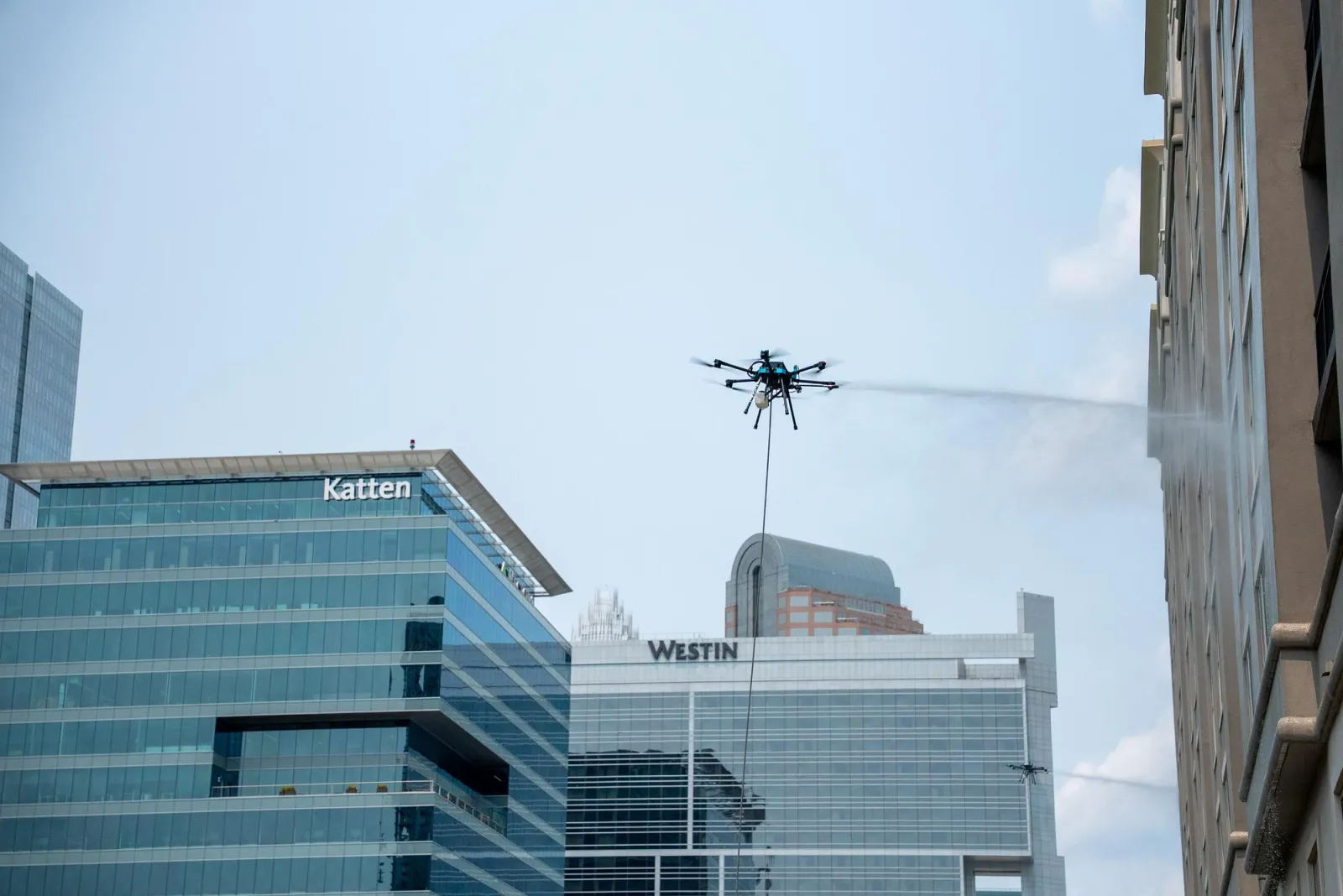
Lucid Bots is a Charlotte, North Carolina company producing autonomous drones for exterior building cleaning and maintenance. Its primary product, the Sherpa, is a hexacopter designed to clean building facades, solar panels, and other elevated surfaces without requiring workers to operate at height. The company sells to commercial cleaning operators rather than end building owners. More than 400 operators have deployed the platform across 40 US states.
Key Products
Sherpa: Six-motor cleaning drone built on a stainless steel and aluminum airframe rated IPX5 for water resistance, delivering up to 26.5 lbs of thrust per motor. Battery endurance is approximately 19 minutes per charge. Designed for exterior building facades, curtain walls, and solar arrays.
Lavo: Ground-based cleaning robot for surfaces accessible without aerial operations, sold alongside the Sherpa as part of an integrated cleaning solution.
Business and Funding
Lucid Bots is private. In March 2026 it raised an oversubscribed $20 million Series B co-led by Cubit Capital and Idea Fund Partners, with participation from WaterStone Impact Fund, Front Porch Ventures and the investor Taylor Rhodes, bringing total funding to $34 million.
The company said the proceeds would scale commercial operations, expand domestic manufacturing in Charlotte, and accelerate the rollout of Lucid Refresh, a subscription robots-as-a-service offering for exterior cleaning operators. At the time of the round it said its operator network had passed $75 million in jobs completed and was approaching 1,000 robots deployed nationwide. Those are company figures.
Why It Matters
Lucid Bots operates in a niche that sidesteps most of the regulatory difficulty of autonomous flight. Cleaning the outside of a building is a repeatable job with a measurable labour cost to displace, performed over private property rather than through controlled airspace, so the company competes on unit economics rather than on certification timelines.
The $75 million of work completed through its operator network is the more useful signal than the funding, because it is revenue earned by third parties using the product rather than the company’s own projection. The shift toward a subscription model is the thing to watch: selling robots and renting them out are different businesses with different capital requirements, and the Series B is funding a transition between them.