
Kraken Technology Group
UK maritime defence company building high-speed uncrewed surface vessels, whose K3 Scout was selected by the Royal Navy in 2026 and which raised $175 million at a $1 billion valuation.
1 article
Kraken Technology Group builds high-speed uncrewed surface vessels for defence and security customers. It was founded in 2020 by Mal Crease and is based in Fareham, on England’s south coast, with a reported workforce of close to 200. It is a different company from Kraken Robotics, the listed Canadian subsea sonar and battery manufacturer, and the two are frequently confused.
Kraken’s proposition is production rate rather than a single exquisite platform: composite hulls and modular payload bays built to be turned out quickly and, in the smaller classes, treated as attritable.
Vessels
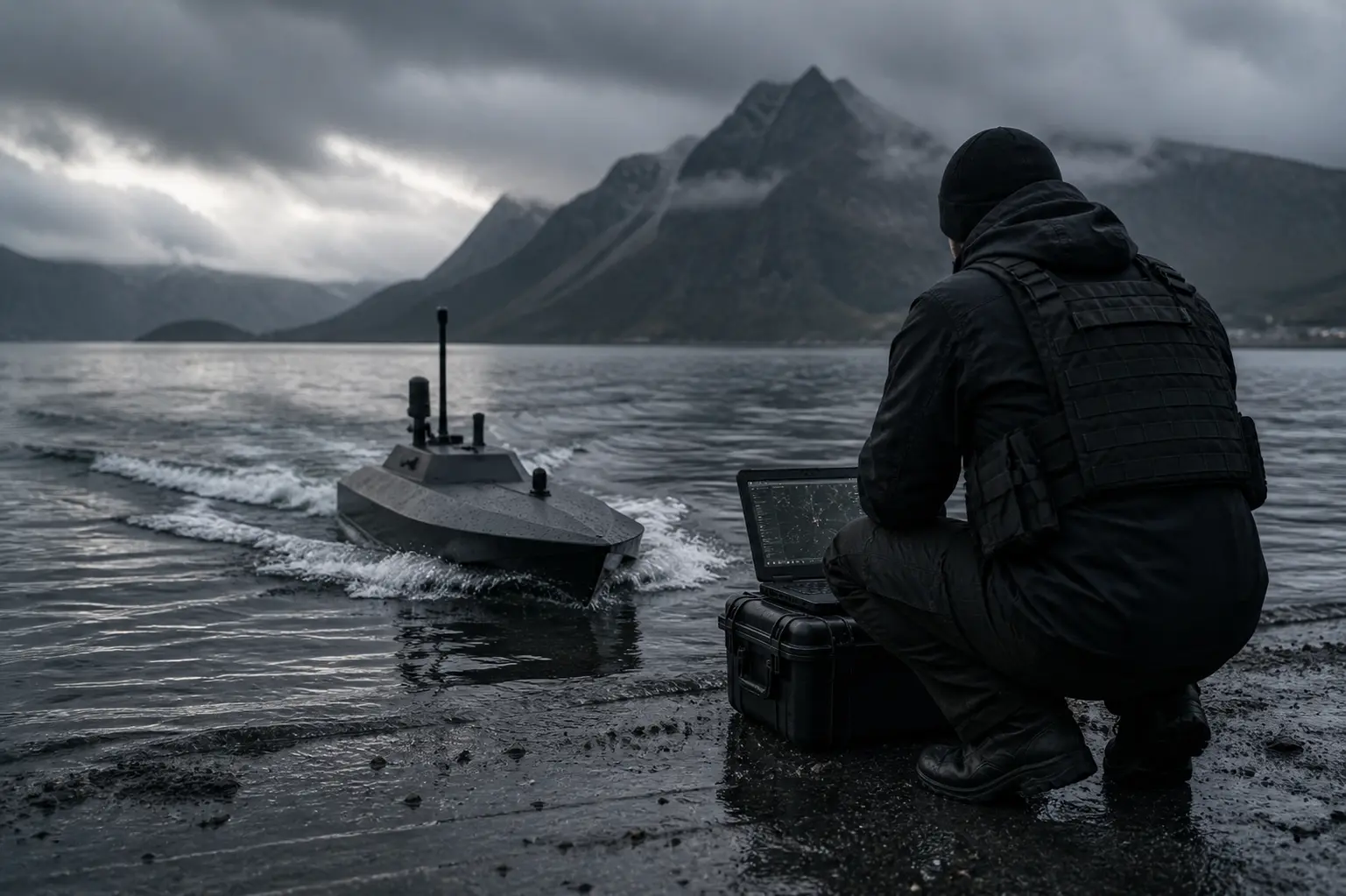
K3 Scout — the flagship, and the vessel with the real order book. An 8.4-metre diesel USV with roughly 1.9-metre beam, a stated 55 knots and a 600 kg modular payload. Kraken lists anti-surface warfare, forward screening, littoral strike, counter-UAS detect-and-defeat and electronic warfare among its roles.
K4 Manta — a hybrid platform combining hydrofoiling surface transit with subsurface capability.
K5 Kraken — an 11.1-metre heavily armed USV.
K7 Sabre — a 26-metre medium USV for longer-range transit with containerised payloads. Kraken says it expects to complete engineering development before the end of 2026, which means it is not yet a delivered product.
Contracts and Financial Position
In March 2026 the UK Ministry of Defence awarded Kraken a £12.3 million contract to deliver 20 K3 Scout vessels to the Royal Navy’s Surface Flotilla under Project Beehive, alongside training and warfare development support. Kraken beat 11 other bidders, including BAE Systems, L3Harris and Kongsberg — which is the substantive point about the award, more than its size.
In November 2025 US Special Operations Command awarded Kraken an Other Transaction Authority agreement capped at $49 million to develop next-generation uncrewed surface and subsurface vessels.
On 9 July 2026 Kraken closed a $175 million Series B at a $1 billion valuation, led by DTCP Defence with Rheinmetall, the NATO Innovation Fund, the British Business Bank, the UK National Security Strategic Investment Fund, Estonia’s SmartCap, Inocea, Notion Capital, Speedinvest and others participating. Total funding to date has not been disclosed. Neither has revenue: Kraken is privately held and files as a UK company with limited public disclosure.
Growth is coming through licensed manufacture rather than owned yards. Kraken has partnerships with Rheinmetall in Germany (August 2025), Anduril Industries in the US (April 2026, covering licensed US production of the K5 and K7) and Davie in Canada (May 2026). The company states UK capacity of up to 1,000 units a year and a similar figure in Germany; those are stated capacities, not output.
Why It Matters
Kraken is the clearest European example of a small attritable USV moving from demonstrator to programme of record, and Project Beehive gives it something most maritime autonomy startups lack: vessels in a navy’s hands rather than in a trials programme.
The weaknesses are visible. A $1 billion valuation rests on a £12.3 million domestic contract, a capped US development agreement, and licensing deals whose volumes are unproven. Three of its four platforms are not yet in service, and the strategy of scaling through partners means Kraken captures a licensing margin rather than the build.