
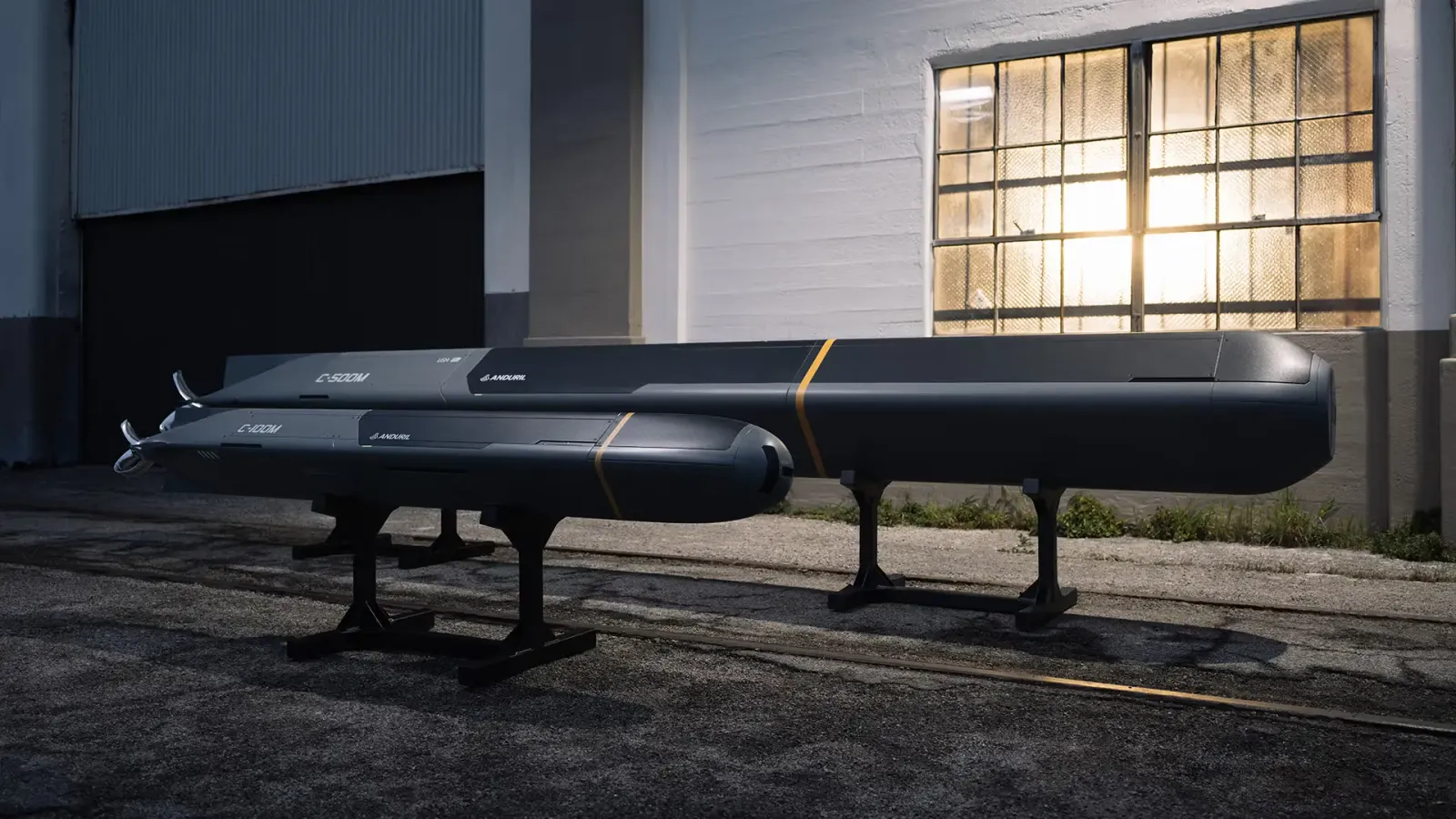
Anduril released the first public footage of its Copperhead-500M on April 25, showing the 21-inch autonomous underwater munition breaking internal speed records while executing high-agility maneuvers in rough seas. The test moves the Copperhead program from a design architecture into a demonstrated capability — and positions Anduril squarely in the business of autonomous undersea strike, not just surveillance.
The Copperhead-500M is a heavyweight-class autonomous underwater vehicle built to deliver strike effects from unmanned carriers rather than crewed submarines. Its 21-inch diameter places it in the same dimensional category as legacy torpedoes, but the operational logic is fundamentally different.
Four Variants, One Architecture
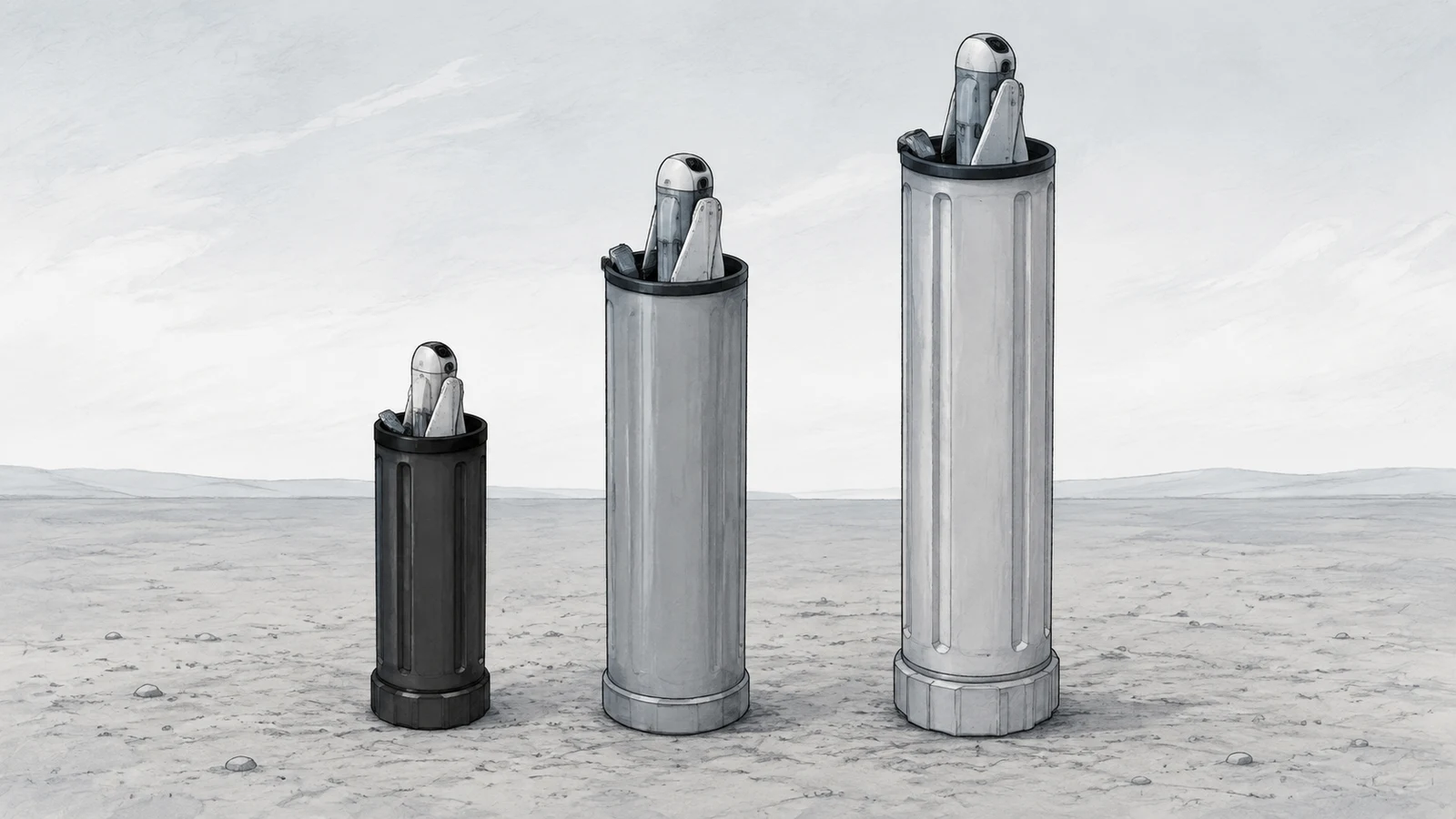
Anduril has structured Copperhead as a family rather than a single product: the 12.75-inch Copperhead-100 and 21-inch Copperhead-500 handle reconnaissance, sensing, and payload delivery, while the Copperhead-100M and Copperhead-500M convert the same airframe logic into kinetic weapons. The architecture means a single underwater network can mix surveillance and strike vehicles built around common design principles — the same family that maps a harbor approach can mine it.
The 500M is the most consequential member because it crosses the threshold into heavyweight strike. Anduril has described its larger Dive-XL autonomous underwater vehicle as capable of carrying multiple Copperhead-500M systems, which means a single unmanned carrier could pre-position, patrol a chokepoint, and release strike munitions without any crewed platform in the vicinity. The Copperhead-100M adds numbers to that equation — smaller, deployable in greater volume, useful for saturation or area-denial roles where mass matters more than individual payload weight.
Why Autonomy Is the Entire Point
Underwater warfare imposes constraints that make autonomous operation not a feature but a requirement. Unlike aerial drones, AUVs cannot maintain constant high-bandwidth control links. They navigate without GPS, communicate through narrow acoustic channels, and must make engagement decisions based on pre-mission parameters or intermittent updates from command systems. For the Copperhead-500M, the speed and agility demonstrated in the sea trials matter less as performance statistics than as evidence that the vehicle can function autonomously under the conditions — rough seas, limited comms, fast-moving targets — where it would actually be used.
The traditional torpedo model is expensive, produced in limited numbers, and tied to a small pool of high-value launch platforms. Every heavyweight torpedo engagement today requires a crewed submarine or surface combatant within engagement range. Copperhead-500M is designed to decouple heavyweight undersea strike from crewed platform proximity — letting unmanned carriers pre-position in contested areas, hold them at risk indefinitely, and release strike AUVs on cue. The economics look different when the launch platform is expendable and the munition is software-defined.
The Theaters Where This Matters
The Indo-Pacific is the obvious reference point, but the operational logic applies across any contested maritime environment — the Baltic approaches, North Atlantic submarine corridors, Black Sea infrastructure, and littoral chokepoints in the Middle East. A force deploying networked Copperhead systems could complicate adversary submarine operations, threaten surface combatants moving through confined waters, and force sustained investment in mine countermeasures and unmanned system detection across large ocean areas.
None of that replaces nuclear-powered submarines or the legacy torpedo inventory. What it adds is attritable mass — the ability to distribute heavyweight undersea effects across a larger area, from more unpredictable positions, without the political and operational cost of exposing crewed platforms. The same calculus that made FPV drones strategically relevant in Ukraine applies underwater: when the attacking system is cheap enough to lose, the defender has to spend disproportionately to stop it.
Anduril has taken Copperhead from architecture to sea trial footage in a compressed timeline. The gap between demonstrated test performance and operational integration into Navy unmanned programs is where the program’s trajectory will be decided — and that decision will depend heavily on how the service structures its distributed maritime systems acquisition over the next two budget cycles.