
Teal Drones
US maker of NDAA-compliant tactical reconnaissance drones and the Red Cat Holdings subsidiary supplying the US Army's Short Range Reconnaissance programme.
1 article
Teal Drones builds small unmanned aircraft for military and government users from a facility in Salt Lake City, Utah. It was founded in 2014 by George Matus, then 17, and acquired by Red Cat Holdings in 2021. It is now Red Cat’s principal defence airframe business. Its pitch is built almost entirely on provenance and procurement eligibility: US-designed, US-built, NDAA-compliant, and — the company says — Blue UAS certified, with encrypted datalinks.
Aircraft
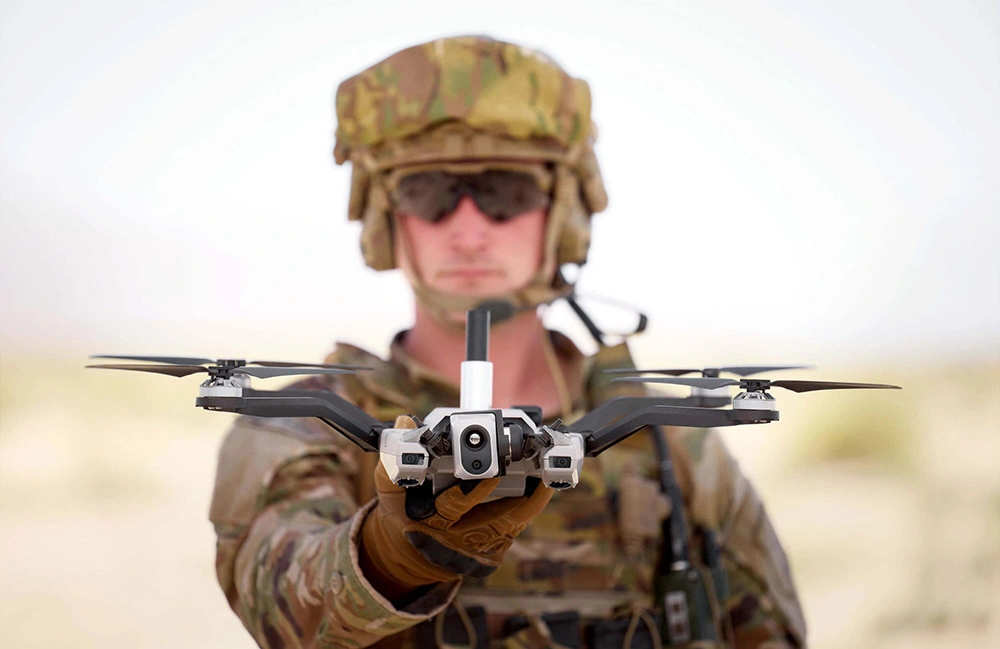
Black Widow is the flagship: a rucksack-portable ISR quadcopter under three pounds, carrying a Teledyne FLIR Hadron 640R+ EO/IR payload, with endurance the company puts at 45-plus minutes and a link range of roughly 8 km. Hellcat is a dual-use configuration on the same platform, which Teal says reflects operator feedback and lessons from work with Ukraine. Teal 2, the previous generation, is still listed and still fielded, and Fang is an FPV airframe. Golden Eagle, which an earlier version of this profile listed, is no longer part of the line.
Programmes
The company’s position rests heavily on one award. On 19 November 2024 the US Army selected Black Widow as its Short Range Reconnaissance Program of Record system, against a stated acquisition objective of 5,880 systems over a five-year period of performance. That is an objective, not an order book, and deliveries have come in increments — including a $9.5 million Army purchase order in May 2026 for second-quarter delivery. Black Widow was added to the NATO Support and Procurement Agency catalogue in September 2025, and Red Cat has announced competitive-tender wins with an Asia-Pacific ally in December 2025 and a NATO ally in March 2026, neither named nor sized. In July 2026 the US Air Force placed a $2.49 million order to evaluate Black Widow — notably against Teal’s own Teal 2, the Security Forces incumbent.
Financial position
Teal does not report separately; Red Cat (Nasdaq: RCAT) does. Red Cat’s 2025 revenue was $40.7 million, up 161% year on year, against a net loss of $72.1 million. For the quarter ended 30 June 2026, revenue was $20.2 million, up 527%, but gross margin was 16.1% and the net loss $35.3 million. Cash stood at $325.6 million and inventory including prepaid inventory at $84.8 million. Red Cat reaffirmed full-year 2026 revenue guidance of $150 million to $180 million, which implies a very heavy second half. Teal’s own footprint was 37,000 square feet as of 31 December 2025.
Why it matters
Teal is the clearest test of whether an American small-drone manufacturer can hold a programme of record at volume. Winning SRR was the hard part; converting an acquisition objective into delivered units at a workable margin is the part still unproven. A 16.1% gross margin on hardware at this scale is thin, and group losses remain large relative to revenue.
Two risks sit close to the business. It is effectively a single-programme company inside a group that keeps acquiring others. And founder George Matus left in December 2024; in August 2025 Red Cat and Teal sued him and his new venture in the US District Court for the District of Utah, alleging trade-secret misappropriation.