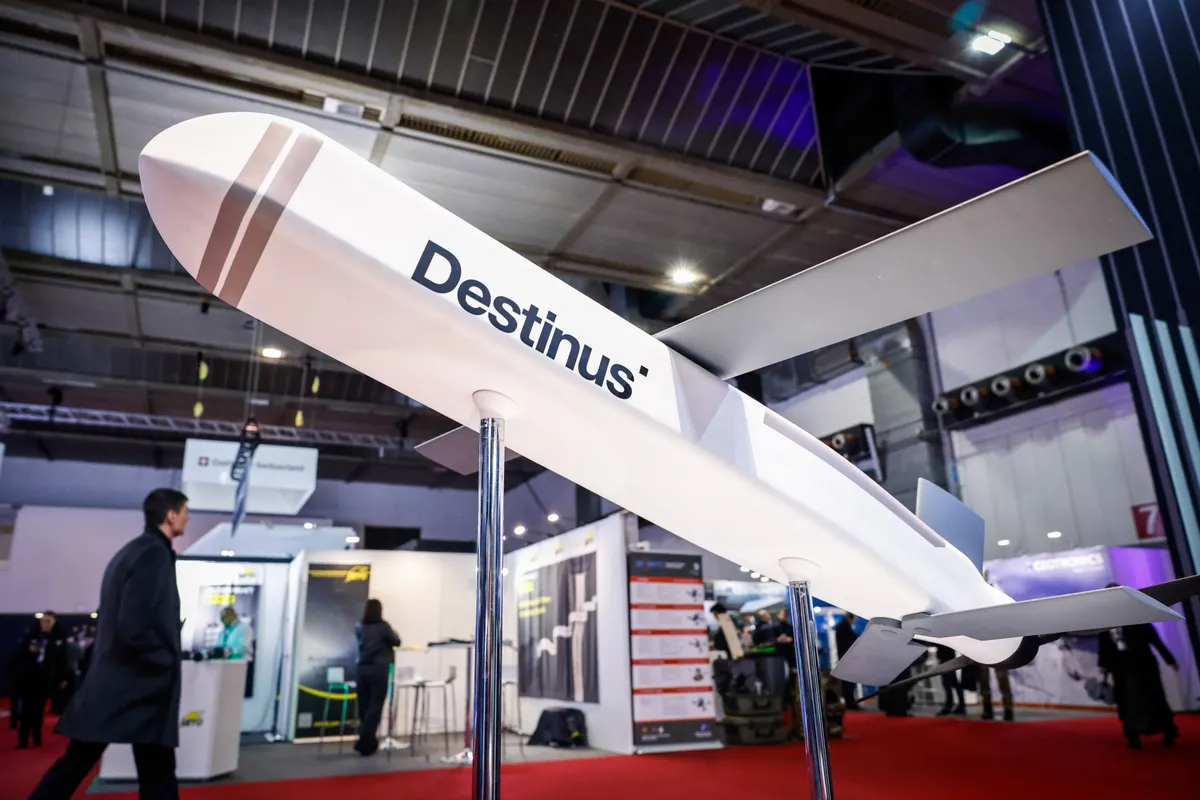

Destinus
Netherlands-headquartered defence manufacturer producing cruise missiles, interceptor drones and turbojet engines for European militaries, and leading the Bliksem EXO ballistic missile defence consortium.
1 article
Destinus
Destinus Group BV was founded in March 2021 by Mikhail Kokorich, a Russian-born entrepreneur who previously founded Dauria, Astro Digital and Momentus and who renounced his Russian citizenship after the full-scale invasion of Ukraine. The company began in Payerne, Switzerland as a hydrogen-powered hypersonic aircraft venture and moved its headquarters to Hengelo in the Netherlands in November 2024, a move reported as driven by Swiss arms-export restrictions. It sells to European defence ministries, and to Ukraine through Dutch government procurement.
Key Products
Ruta — the family of turbojet-powered cruise missiles, in Blocks 1 to 3, that Destinus is best known for. Rheinmetall’s April 2026 announcement referred to Destinus systems already operationally validated and used in Ukraine, without naming a variant. In June 2026 the Netherlands ordered 700 Ruta Block 2 missiles for Ukraine in a deal reported at €250 million.
Hornet — a canister-launched interceptor for defeating cheap aerial threats. Block 1 is in serial production; Block 2 uses a rocket booster and folding wings for electric cruise flight. In August 2026 the Dutch procurement agency COMMIT signed a concept development and evaluation contract running to Q2 2027 to deliver Hornet B2 and integrate it with Royal Netherlands Navy warships.
Kryla — a lower-cost cruise missile the company positions for launch in volume, and one of the two initial products named for the Rheinmetall joint venture.
Vorexon — a point-defence interceptor concept against rocket artillery, shown at Farnborough in July 2026. Destinus says prototypes are flying in Spain, with testing planned for 2027 and production for 2028. Nothing has been fielded.
The company also builds its own turbojet engines, holds the OPRA gas turbine business it bought in 2023 as Destinus Energy, and completed the CHF 180 million (about $225 million) acquisition of Zurich AI avionics firm Daedalean on 5 January 2026; Daedalean chief executive Bas Gouverneur became Destinus’ chief military program officer. The hypersonic demonstrators the company started with — Jungfrau, Eiger — are no longer the centre of the business.
Business and Financial Position
Destinus is private. In December 2025 it announced a €50 million facility from Commerzbank, its first commercial bank financing, alongside €140 million of convertible instruments and shareholder loans and more than €200 million of prior equity, putting total capital raised at close to €400 million. It said then that it employed around 750 engineers and specialists. Bloomberg reported in May 2026 that the company was seeking roughly €200 million pre-IPO at a valuation above €5 billion, working with Rothschild and UniCredit, and weighing an Amsterdam listing; there is no public confirmation that round has closed. Rheinmetall’s April 2026 announcement said Destinus produces more than 2,000 cruise missile systems a year. Revenue is not disclosed.
Why It Matters
Destinus has moved from demonstrator company to system supplier faster than almost anyone in European defence, and two 2026 agreements show how far the credibility has travelled. Rheinmetall agreed on 13 April 2026 to form Rheinmetall Destinus Strike Systems at Unterlüß in Lower Saxony, 51% Rheinmetall and 49% Destinus, to build cruise missiles and ballistic rocket artillery around a 2,000 km-range Ruta Block 3; the two said they intended to form it in the second half of 2026, subject to regulatory approval. On 14 July 2026 Destinus signed a letter of intent in Paris to lead the Bliksem EXO consortium with MBDA Deutschland, Safran Electronics & Defense, Airbus Defence and Space and Thales, taking system integration and the exo-atmospheric kill vehicle for a European mid-course interceptor, with a test in space targeted for 2027.
That is a five-year-old company leading a consortium of Europe’s largest missile houses, which is either the point or the problem. The output figures and production tempo come from the company and its partners rather than from audited disclosure, the pre-IPO round is reported rather than confirmed, and the Bliksem EXO agreement is a letter of intent with a binding agreement still to follow. Destinus has also grown substantially by acquisition, which is a different risk profile from building the capability in-house.