
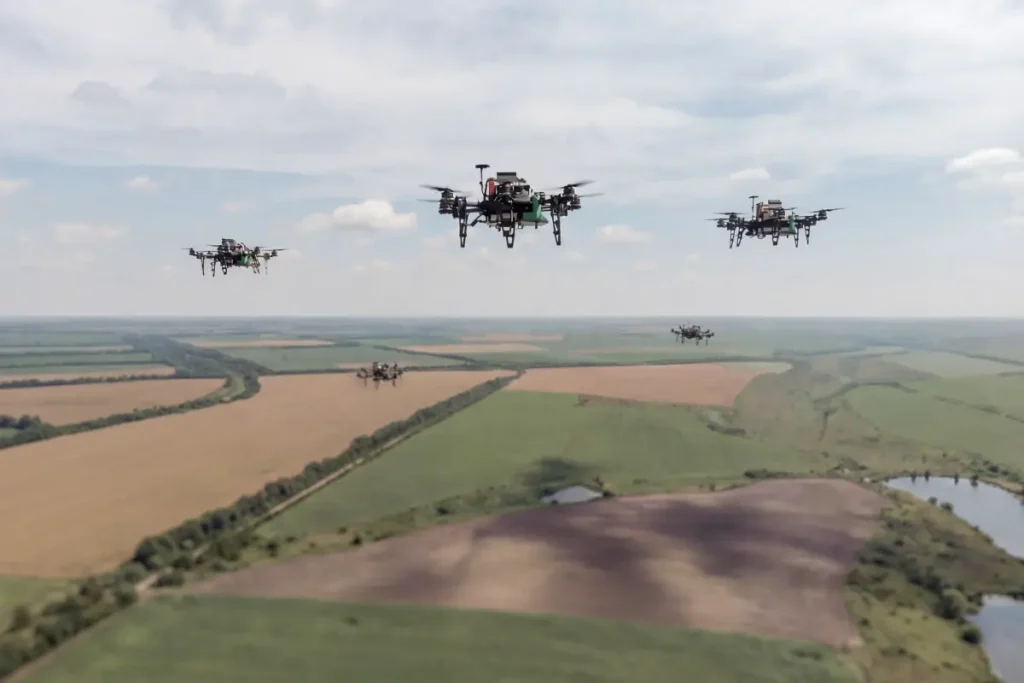
Since April 2024, Swarmer’s autonomous drone coordination software has been deployed in active combat in Ukraine, accumulating more than 100,000 real-world missions. That number isn’t a projection — it’s operational data feeding directly back into the company’s machine-learning models.
Swarmer builds software that sits above the hardware layer. One operator sets an objective; the system distributes tasks across the swarm, handles navigation, manages failures, and adapts in real time — without GPS if necessary, and with limited communication if required. The company defines a “swarm” precisely: every drone knows the status of every other drone, decisions are decentralized, and there is no single point of failure. A single swarm can currently include up to 690 drones.
What Decentralized Coordination Actually Means
The distinction between a large drone attack and an actual swarm matters tactically. Russia regularly launches mass drone strikes against Ukraine, but those are sequential waves with human operators — not coordinated autonomous systems. Swarmer’s architecture is different. Each drone continuously recalculates its position and role relative to every other platform. If one is destroyed, the others immediately redistribute responsibilities and re-approach from different vectors.
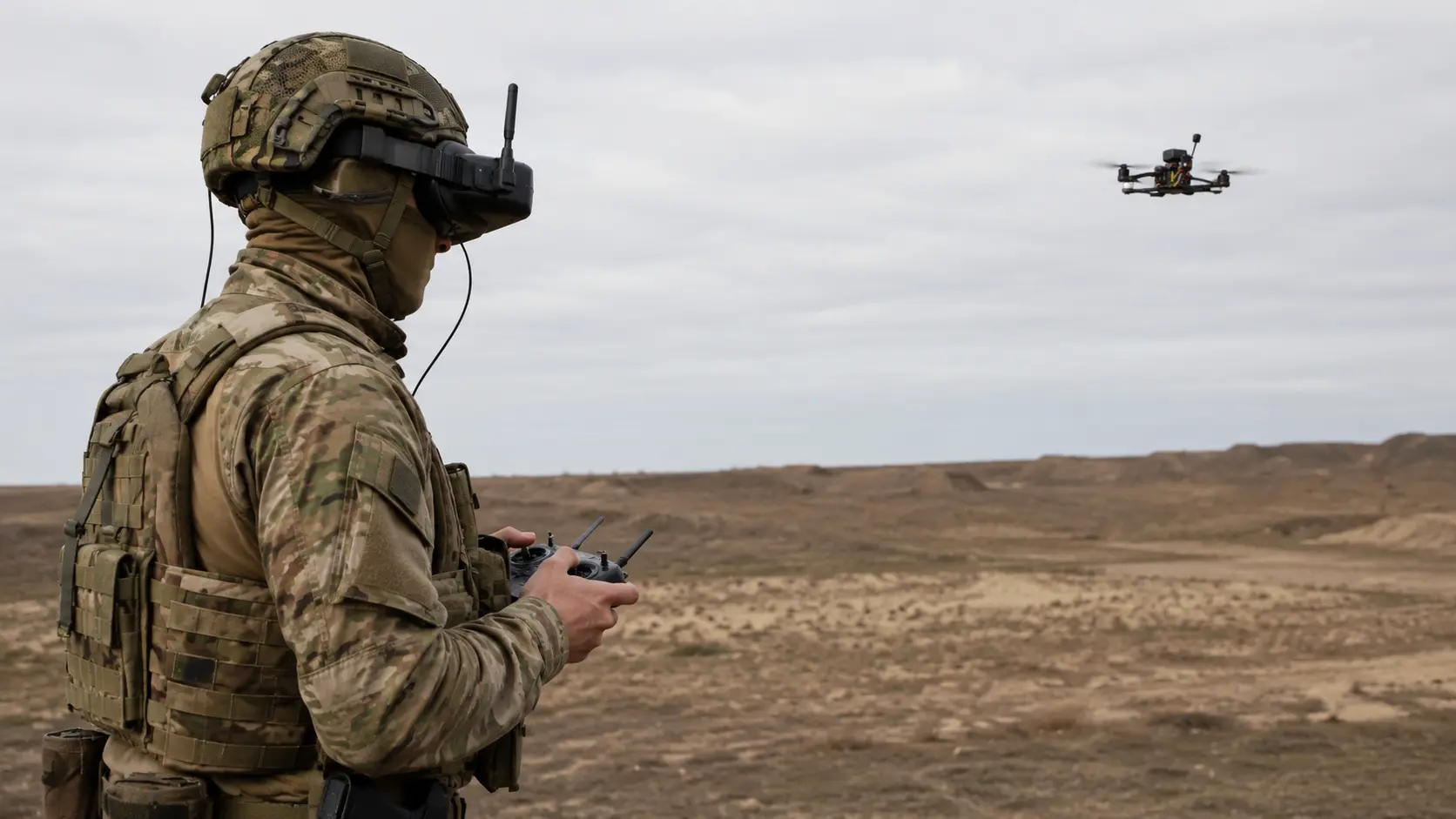
CEO Serhii Kupriienko describes the current focus as groups of ten or more FPVs operating with coordinated autonomy. The decision-making authority assigned to the system is deliberately bounded — drones don’t independently select targets. A human assigns the objective and carries responsibility for the kill box, the same doctrinal framing NATO uses for artillery. The drones execute within those constraints.
That framing is significant. Swarmer is threading a needle between full autonomy — which triggers legal and ethical landmines — and the micromanagement model that limits how fast swarms can actually operate. The operator remains responsible. The system handles the execution.
The Engineering Problem Nobody Has Fully Solved
Kupriienko is candid about the difficulty. True cooperative autonomy requires not just advanced AI but new training models, supercomputing infrastructure, and tight hardware-software integration. Failure modes in a swarm aren’t isolated — a navigation error or communication loss can cascade. The company uses an automotive industry testing framework: minimize error rates, ensure every failure is traceable, prevent recurrence. The analogy to self-driving cars is apt, and so is the implication: the industry spent a decade and billions of dollars getting to partial deployment.
Around one to two dozen Ukrainian companies are working on swarm solutions, according to Kupriienko. The field is early, competitive, and heavily shaped by live combat feedback that no Western lab environment can replicate.
On April 29, Swarmer announced a partnership with HIMERA, a Ukrainian tactical radio manufacturer, to integrate jam-resistant communications directly into its autonomy stack — addressing one of the most common swarm failure modes: electronic warfare disruption.
Swarmer went public on Nasdaq in March under the ticker SWMR, raising approximately $15 million. The IPO proceeds are allocated primarily to accelerating integration across drone platforms and client systems. With 100,000 combat missions logged and a radio partnership that addresses the electronic warfare gap, the company’s next milestone is scaling from groups of ten FPVs to the upper limit of its 690-drone architecture in active operations.