
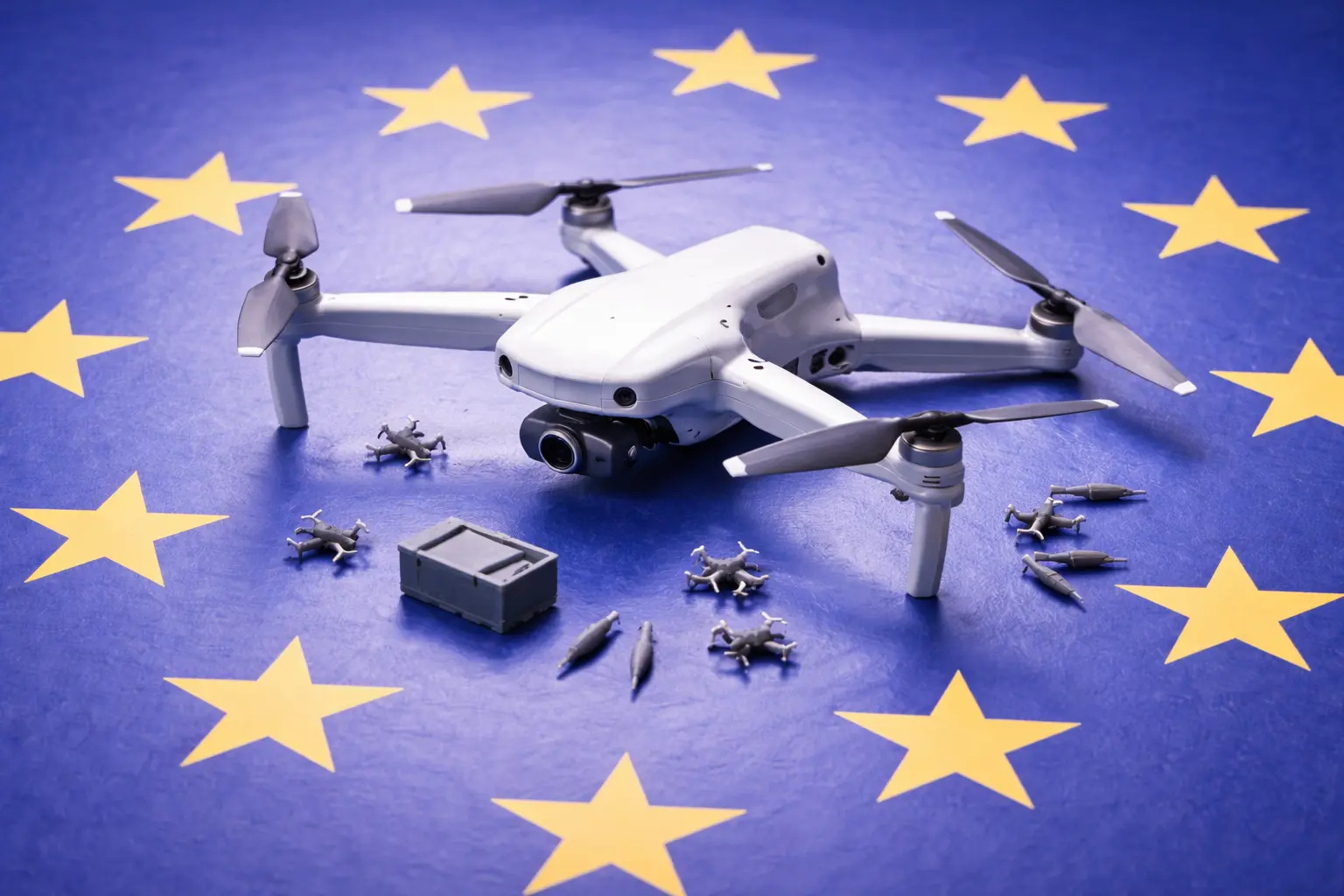
Drone technology evolves every three to six months. European defence procurement takes years. That gap is now a strategic liability.
Before Russia’s invasion of Ukraine, no European military fielded more than 2,000 drones. Both armies are now burning through up to seven million units annually. Ukraine doubled output from 2.2 million units in 2024 to 4.5 million in 2025. The volume is extraordinary — but volume isn’t the problem Europe needs to solve.
The Procurement Paradox
“Drones evolve technologically every three to six months,” says Nikolaus Lang, Managing Director at BCG and co-author of a recent analysis with General Lavigne. “So it’s challenging to buy millions of drones that will be obsolete in 12 months from now.”
The battlefield evidence is unambiguous. Fibre-optic drones were a novelty in 2024. By 2025, Russian production of a single fibre-optic model reached at least 6,000 units per month. Ukrainian engineering teams have compressed design-to-deployment cycles from months to weeks, using real-time battlefield feedback to update successive generations. European procurement machinery was not built for that tempo.
The Capital Gap Behind the Capability Gap
The deeper problem is investment. The US has put roughly $70 billion into defence venture capital over the last decade. Europe has invested approximately $7 billion — one-tenth. That disparity translates directly into how fast research becomes deployable hardware.
The Pentagon demonstrated multiple American drone prototypes in June 2025, built from off-the-shelf components in an average of 18 months. The standard procurement timeline for comparable systems runs six years.
Scale compounds the problem. The US defence market is a single procurement system worth over $900 billion annually. Europe’s combined defence budgets total around $450 billion, but fragmented across dozens of national systems. Today, 80% of European procurement and 90% of defence R&D remain at the national level. The result is duplication, an inability to achieve production scale, and a research base that generates world-class papers but not battlefield systems.
European drones also carry a structural vulnerability: many rely on Chinese components, a supply chain dependency that creates both operational risk and political friction with NATO partners.
How Long to Close the Gap
Lang’s assessment is five to ten years, assuming Europe increases startup capital, accelerates procurement reform, and accepts that timely deployment outweighs perfect specification. NATO is establishing drone innovation hubs and joint programs to standardise swarm tactics, AI integration, and resilient communications — the building blocks of a sovereign capability stack.
Ukraine is the benchmark. Ukrainian teams are iterating at wartime speed, turning battlefield lessons into engineering changes within weeks. Europe is still running peacetime procurement cycles. Closing that gap before the next crisis forces the issue is, as Lang puts it, the defining defence challenge of this decade.